OTTAWA — Canada’s Federal Court of Appeal has ruled that the federal government acted unreasonably and outside its legal authority when it invoked the Emergencies Act to respond to the 2022 convoy protests, delivering a major rebuke of the most far-reaching executive decision taken during the demonstrations.
In a unanimous decision, the court dismissed the federal government’s appeal of a 2024 Federal Court ruling, confirming that the legal threshold required to declare a public order emergency was not met. The judgment represents the most consequential judicial review to date of the government’s response to the protests, which immobilized parts of downtown Ottawa and disrupted key border crossings for weeks.
The Emergencies Act, which replaced the War Measures Act in 1988, grants cabinet sweeping temporary powers but is designed to be used only as a last resort, when a situation constitutes a national emergency and cannot be effectively addressed through existing laws. The appeal court found that this standard was not satisfied in February 2022.
While the court acknowledged that the protests created serious public order challenges and economic disruption, it concluded that the evidence before cabinet did not establish the existence of a qualifying threat to the security of Canada, nor demonstrate that federal and provincial authorities lacked adequate legal tools to respond.
The judges also upheld findings that certain measures enacted under the declaration — including broad financial restrictions targeting individuals and entities linked to the protests — infringed constitutional protections. Those violations, the court found, were not justified under the Charter.
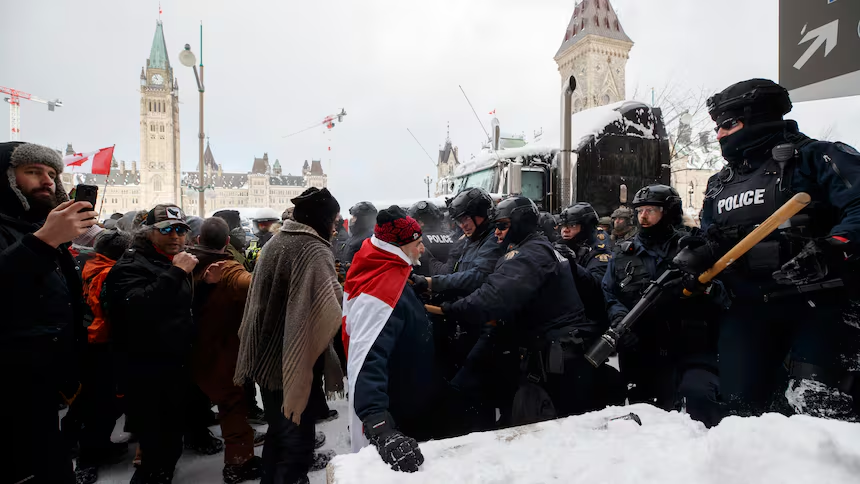
The convoy protests began in late January 2022, initially opposing COVID-19 public health measures before evolving into an entrenched occupation of Ottawa’s core. Similar demonstrations and blockades emerged across the country, including at several border crossings vital to trade with the United States. After weeks of stalled negotiations and uneven enforcement, the federal government invoked the Emergencies Act on Feb. 14, 2022.
The declaration empowered cabinet to create temporary regulations restricting participation in certain assemblies, compelling services such as towing, and expanding the ability of financial institutions to freeze accounts associated with the protests. Police cleared the Ottawa encampment within days, and the emergency declaration was revoked on Feb. 23.
At the time, the government argued that the scale, coordination, and persistence of the protests exceeded the capacity of existing laws and posed a national crisis requiring centralized federal action. That position was later endorsed by a public inquiry, which concluded that the legal threshold to invoke the Act had been met — a conclusion now at odds with the courts.
The appeal court’s ruling leaves the lower-court decision intact and further sharpens that divide. While the judgment does not invalidate arrests or enforcement actions taken during the emergency, it strengthens civil lawsuits already underway and reshapes the legal record surrounding the government’s justification for invoking extraordinary powers.
The federal government, led by Justin Trudeau, has said it is reviewing the decision and considering whether to seek leave to appeal to the Supreme Court of Canada. Such an appeal would require the court’s permission and could determine whether the Federal Court of Appeal’s interpretation becomes the final word on the limits of the Emergencies Act.
Beyond the immediate legal consequences, the ruling reinforces the high bar Parliament intended for emergency powers and signals a cautious judicial approach to their use in domestic crises. It underscores that even in moments of significant disruption, courts will closely scrutinize executive decisions that curtail civil liberties — including long after the protests themselves have ended