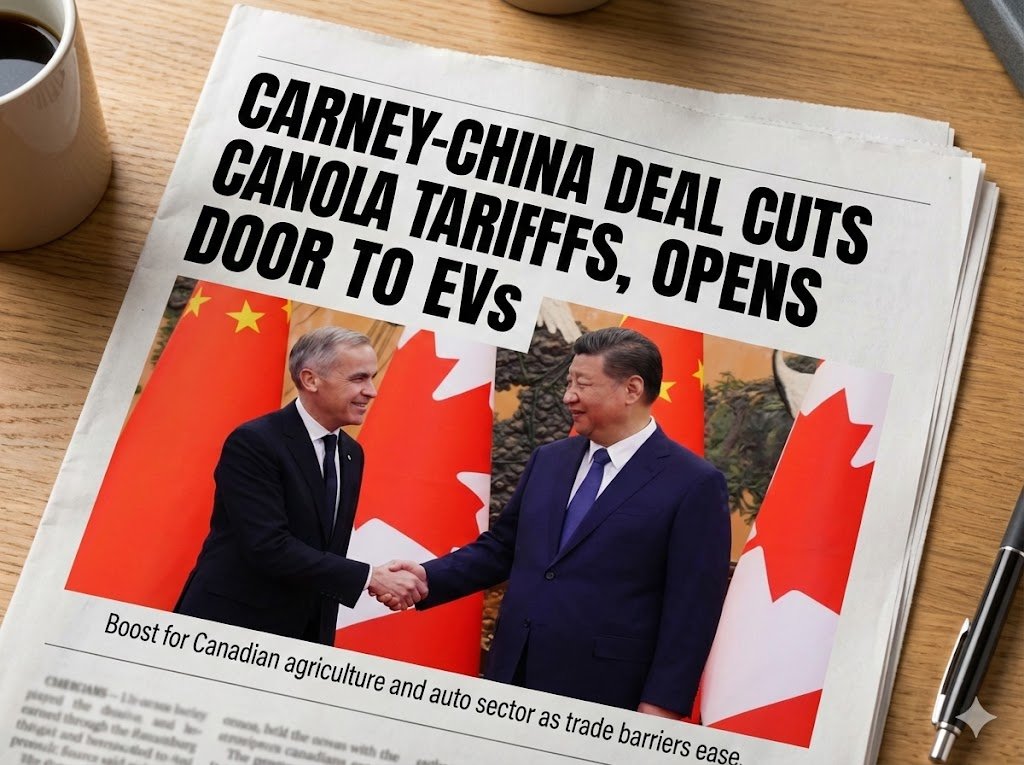
BEIJING — Prime Minister Mark Carney has announced a new trade deal with China that would lower Chinese tariffs on Canadian canola and other products while giving Chinese-made electric vehicles some access to the Canadian auto market, a move that could ease pressure for Prairie exporters but sharpen political and economic tensions in Ontario.
Carney unveiled the agreement during a trip to China that has been framed by shifting global trade dynamics and renewed uncertainty in Canada’s relationship with the United States. Analysts have linked the push for closer Canadian ties with China to concerns about U.S. President Donald Trump’s threats and unpredictability on trade, which have added urgency for Canada to diversify markets and reduce exposure to abrupt policy swings.
The deal’s broad outline points to a two-way exchange: improved terms for Canadian agricultural exports, particularly canola, and a pathway—however limited—for Chinese electric vehicles to enter Canada’s tightly watched auto marketplace. The combination lands differently across the country, offering tangible upside to farm exporters while raising new questions for regions anchored by auto manufacturing and supply chains.
Relief for canola exporters, new friction for auto country
Canola is a pillar export for Western Canada, and the reduction in Chinese tariffs is being welcomed by producers and communities that rely on the crop’s international sales. The change is being treated as a practical win for farm country after a period of strained market conditions tied to tariff levels that had hit returns.
At the same time, the electric-vehicle component of the agreement risks becoming a flashpoint. Allowing Chinese EVs “some access” to Canada’s auto market, as described in the announcement, has the potential to trigger resistance among domestic manufacturers and workers worried about competition, pricing pressure and the broader industrial strategy behind Canada’s transition to electric vehicles.
Observers have already portrayed the trade-off in political terms: easing canola barriers is expected to benefit Prairie provinces, while the EV opening could be received as a direct challenge in Ontario, where automotive jobs and investment are concentrated and where decisions about market access can quickly become a high-stakes political issue.
- The deal would lower Chinese tariffs on Canadian canola and other products.
- Chinese electric vehicles would gain some level of access to the Canadian market.
- The agreement highlights the tension between export gains for agriculture and sensitivity in Canada’s auto sector.
Background: a major pivot after hard-edged campaign language
The agreement also underscores a notable shift in tone from Carney’s earlier public positioning. During his election campaign, Carney had described China as the number one security threat to Canada—a statement that put national security considerations at the forefront of the relationship and aligned with years of heightened caution in Ottawa about Beijing.
Now, by pursuing a trade package that reduces barriers and expands commercial access, the federal government is signalling that economic imperatives and broader geopolitical pressures are reshaping the way it approaches China. The move lands in a landscape where Canada is balancing competing priorities: protecting national interests and values, safeguarding key industries, and keeping export markets open for sectors that depend on international demand.
Analysts have pointed to Washington’s approach as an accelerant. With Trump’s rhetoric and threats seen as injecting new volatility into trade relationships, Canada’s efforts to strengthen alternative ties are being interpreted as an attempt to reduce vulnerability to sudden policy shocks and to build flexibility in an increasingly tense global environment.
Why the EV question is politically loaded
Even limited access for Chinese EVs touches a sensitive nerve in Canada’s industrial politics. The auto sector is both economically significant and symbolically powerful, tied to decades of manufacturing identity, unionized workforces and large-scale investment decisions that often hinge on government policy.
As Canada moves deeper into electrification, market access decisions are being watched closely for what they signal about the country’s long-term strategy: whether it prioritizes domestic production, protects existing supply chains, and how it balances consumer affordability with industrial competitiveness.
The prospect of Chinese-made EVs entering the Canadian market also carries a broader political charge, given the wider debate over how Canada should engage with China. For critics of deeper engagement, the concern is that trade and market openings can outpace the country’s ability to manage strategic risks. For supporters, the argument is that Canada must keep options open in a world where economic relationships are increasingly shaped by power politics.
What happens next
Carney’s trip does not end in China. From Beijing, he travelled on to Qatar, where he has been seeking to build new economic ties and broaden Canada’s commercial relationships beyond its traditional partners. The stop reflects a wider push to expand trade and investment links as global uncertainty rises and major powers use tariffs and other tools more aggressively.
The immediate next steps for the China agreement will centre on implementation of the tariff reductions for canola and other products and the practical contours of what “some access” for Chinese EVs means in regulatory and market terms. That practical definition—how the access is structured and how it interacts with Canada’s existing policies—will shape the domestic response and determine how quickly the agreement translates into real-world changes.
As the government continues its outreach abroad, the deal is likely to be tested at home: by farmers who want predictable access and stable returns, by industry leaders and workers looking for clarity and protection, and by political opponents ready to frame the agreement as either pragmatic diversification or an unnecessary concession.
For Canadians, the significance lies in what the deal reveals about the country’s current moment: a push to keep key exports moving, an attempt to navigate rising geopolitical volatility, and a growing debate over how Canada balances economic need with industrial priorities and security concerns.