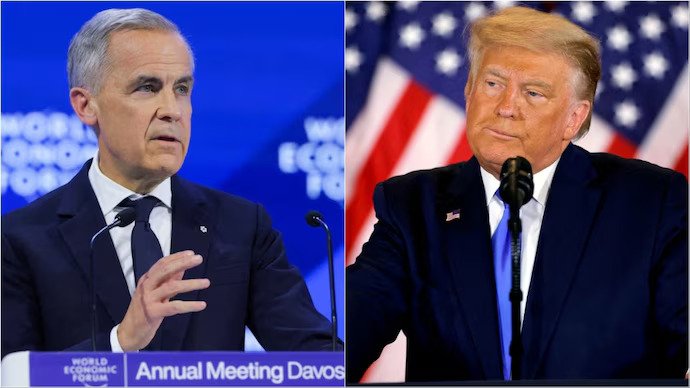
DAVOS, Switzerland — Prime Minister Mark Carney used a World Economic Forum speech this week to argue that the rules-based international order is breaking down and that countries like Canada must respond with new alliances and greater self-reliance, remarks that quickly drew a sharp public response from U.S. President Donald Trump and renewed concern at home about the economic stakes of a widening trade fight.
Carney’s address framed the current moment as a decisive shift in global politics and economics, warning that powerful countries are increasingly using trade and finance to pressure others. He told the Davos audience the world is “in the midst of a rupture, not a transition,” and said middle powers should stop pretending old guarantees still hold.
Without naming Trump, Carney criticized the idea that smaller and mid-sized countries can stay safe by quietly accommodating stronger partners. “Go along to get along” no longer works, he said, adding that compliance “won’t” buy safety.
Trump responded in his own Davos remarks by taking aim at Carney and Canada, saying Canada should be “grateful” for what it gets from the United States and declaring that “Canada lives because of the United States.”
The exchange put Canada’s economic and diplomatic vulnerability back in the spotlight, particularly in trade-exposed provinces where cross-border commerce underpins jobs and investment. It also underscored how quickly the dispute is stretching beyond tariffs into questions of sovereignty and security in the Arctic.
A more direct message from Canada’s prime minister
Carney’s Davos speech leaned heavily on the idea that global integration is now being turned into leverage. He said great powers are treating “economic integration as weapons,” using “tariffs as leverage,” “financial infrastructure as coercion,” and supply chains as vulnerabilities to exploit.
He argued that when international rules and institutions weaken, countries will feel pressure to build more strategic autonomy in areas like energy, food, critical minerals, finance and supply chains. “When the rules no longer protect you, you must protect yourself,” he said.
But Carney also warned against responding by retreating into isolation. Instead, he urged “coalitions that work — issues by issue,” built among partners with enough shared interests to act together. In one of his most pointed lines, he told the audience that if middle powers are not part of shaping decisions, “we’re on the menu.”
Carney described Canada as well-positioned to navigate the upheaval, pointing to energy resources, critical minerals, capital and a stable political system. He said the country should be candid about the end of the old arrangement: “We know the old order is not coming back,” adding that “nostalgia is not a strategy.”
Trade tensions collide with Arctic politics
The Davos back-and-forth unfolded against intensifying international debate about Greenland after Trump publicly reiterated his interest in the territory and threatened trade consequences for countries that oppose U.S. control of the island.
In recent days, Carney has linked Canada’s position on Greenland to broader principles of sovereignty. Speaking publicly during his Middle East travel, he said Canada was concerned by tariff threats tied to Greenland and emphasized that decisions about Greenland’s future are for Greenland and Denmark to make.
At the same time, senior officials have been weighing a potential Canadian military role in Greenland alongside allies. Planning has included options for Canadian troops to participate in exercises intended to reinforce sovereignty and protect critical infrastructure on the Arctic island, according to two sources familiar with the discussions.
The competing pressures — tariff threats, sovereignty disputes and alliance politics — have made the Arctic a live issue for Canada’s foreign policy and defence posture, and have sharpened the domestic debate about how far Ottawa should go in resisting U.S. pressure while still protecting core economic interests.
- Carney warned that the rules-based order is breaking down and that trade tools are increasingly being used as coercion.
- Trump publicly rebuked Carney in Davos, insisting Canada should be “grateful” and saying the country “lives because of the United States.”
- Ottawa has also faced fallout from Trump’s renewed focus on Greenland, with Canadian officials weighing possible military participation in exercises there.
Alberta’s stakes in the trade fight
In Alberta, the Davos clash landed in a province where energy and commodity exports are central to economic growth and where U.S. market access is a recurring political flashpoint. Provincial leaders and industry groups have long argued that any escalation in tariffs or border frictions can ripple quickly through investment decisions, construction timelines, and employment in sectors tied to resource production and manufacturing supply chains.
Alberta’s premier has previously urged Ottawa to focus on what Canada can offer the United States — including energy, critical minerals and natural gas — as a way to reduce trade pressure and keep negotiations moving. That approach has been framed as a pragmatic effort to speak in terms the U.S. president responds to, rather than leaning on moral appeals or public confrontation.
Carney’s Davos message, however, emphasized that middle powers weaken themselves when they negotiate only bilaterally with a “hegemon,” competing for favour and accepting what is offered. In that sense, his foreign-policy argument and Alberta’s economic instincts collide: one stresses coalition-building and collective leverage, while the other prioritizes immediate commercial stability with Canada’s largest customer.
For Alberta workers and businesses watching from home, the central question is less about the theatrics of Davos than about whether the rhetoric translates into new barriers at the border — or into new markets elsewhere that can reduce Canada’s exposure to sudden policy shifts in Washington.
Background
Canada’s modern prosperity has been built in large part on predictable access to the U.S. market and on confidence that alliances and international institutions can manage disputes. Carney’s Davos speech challenged that assumption directly, arguing that the “bargain” underpinning the postwar era has stopped working and that middle powers need to adapt quickly.
He described a world in which international institutions are under strain and where great-power rivalry dominates decision-making. In that environment, he argued, countries should be more honest about the limits of the old narrative and should build durable networks — trade, investment and political — that can withstand coercive pressure.
Trump’s response, and the renewed attention on Greenland, added an immediate test of how Canada balances economic dependence with sovereignty concerns, particularly in the Arctic and across the transatlantic alliance system.
What happens next
In the short term, attention will be on whether Trump’s rhetoric is followed by concrete trade measures targeting Canada or its allies, and how Ottawa positions itself as the situation around Greenland evolves. Canadian officials have been weighing contingency options for potential military exercises in Greenland alongside allies, but no final decision has been publicly announced.
Diplomatically, Carney’s approach points toward building issue-specific partnerships with other middle powers — a strategy aimed at reducing Canada’s vulnerability to bilateral pressure. Domestically, premiers and industry leaders will keep pressing Ottawa to protect access to the U.S. market while also accelerating efforts to expand trade routes and investment relationships that can soften the blow of future shocks.
The Davos exchange, then, is likely to be remembered less as a moment of stage-managed confrontation and more as a signal of where Canada-U.S. relations may be headed: a period marked by sharper language, higher economic risk, and growing pressure on Canada to prove it can defend both its prosperity and its sovereignty in a more volatile world.