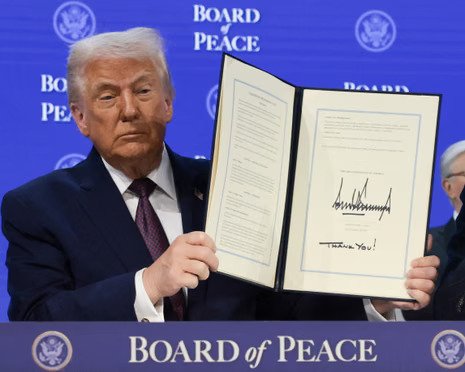
DAVOS, Switzerland — U.S. President Donald Trump used a ceremony at the World Economic Forum on Thursday to launch what he called a new “Board of Peace,” a proposed international body he said could take on major conflicts — starting with Gaza — while requiring a $1-billion contribution for permanent membership.
Trump signed an 11-page founding charter on stage in Davos and said that once the board is fully established, “we can do pretty much whatever we want to do,” framing it as a flexible, action-oriented alternative to traditional diplomacy. The event featured several leaders and senior officials standing alongside him as the documents were signed.
The board was initially conceived as a mechanism linked to Gaza’s reconstruction after the Israel-Hamas war, but the charter signed Thursday does not mention Gaza, signalling a broader ambition for the group’s mandate. Trump said the board could expand to other crises “as we succeed with Gaza,” positioning it as an instrument that could extend beyond the Middle East.
A body with UN-sized ambitions
Trump acknowledged that the board’s sweeping remit has raised concerns it could compete with — or weaken — the United Nations, which has traditionally served as the central international forum for conflict resolution. He said the new body would work with other institutions, including the UN, while arguing the UN has “tremendous potential” that has not been fully realized.
U.S. Secretary of State Marco Rubio, speaking after Trump, said the board’s immediate priority would be ensuring that a Gaza ceasefire becomes “enduring.” Rubio described the group as a “board of action” and suggested its future role could be far-reaching.
Under the plan outlined at the ceremony, Trump will chair the organization alongside what was described as a founding executive council. That group includes Rubio; former U.K. prime minister Tony Blair; Trump’s son-in-law Jared Kushner; U.S. special envoy Steve Witkoff; U.S. deputy national security adviser Robert Gabriel; World Bank Group President Ajay Banga; and Marc Rowan, the chief executive of Apollo Global Management.
Membership invitations and a $1-billion price tag
Trump has billed permanent membership as a premium tier that would require a $1-billion contribution. U.S. officials have said such payments would be voluntary, while still indicating member states would be expected to help fund reconstruction efforts in Gaza.
Officials involved in the initiative have said dozens of countries were invited — roughly 50 to 60 — with up to 25 believed to have agreed to sign on so far. A group of foreign ministers from Pakistan, Egypt, Jordan, the United Arab Emirates, Indonesia, Turkiye, Saudi Arabia and Qatar said in a joint statement that they would be joining. Kuwait’s foreign ministry also said it accepted the invitation.
Other countries identified as having agreed to join include Morocco, Argentina, Hungary, Armenia, Bahrain, Kazakhstan, Kosovo, Uzbekistan, Vietnam and Belarus. Several major powers and many European nations had not publicly responded by the time of Thursday’s ceremony.
- Trump signed a founding charter for the Board of Peace in Davos on Jan. 22, 2026.
- The charter does not mention Gaza, despite the initiative being linked to Gaza’s rebuilding.
- Permanent membership is tied to a proposed $1-billion contribution.
- A group of Middle East and South Asian foreign ministers said they would join in a joint statement.
Refusals and questions about who gets a seat
Not every close U.S. partner is signing on. Britain’s foreign secretary, Yvette Cooper, said the U.K. would opt out, citing concerns about Russian President Vladimir Putin being part of a peace-focused body while the war in Ukraine continues without what she described as clear signs of Russian commitment to peace.
Cooper’s comments also reflected broader scrutiny around invitations extended to leaders facing international condemnation, including Israeli Prime Minister Benjamin Netanyahu. Questions have been raised about the implications of bringing in figures associated with ongoing wars — and about the authority that could accrue to Trump as the inaugural chair.
Russian state media reported that Putin was prepared to send $1 billion to support Palestinians through the Board of Peace, and that the idea of using frozen Russian assets to fund the contribution had been discussed with Washington. Putin has said he is studying the invitation.
Netanyahu, according to reporting around the launch, has agreed to join the board after his office earlier criticized the composition of a subordinate technocratic committee related to Gaza oversight.
One conspicuous absence remains: there is no Palestinian representative on the board.
Background: from Gaza rebuilding to a wider mandate
Trump and his aides have portrayed the board as an outgrowth of efforts to lock in a ceasefire and move toward reconstruction in Gaza after a devastating war. At the Davos ceremony, Trump praised U.S. officials for their work on the ceasefire and declared, “We have peace in the Middle East,” emphasizing that he believes conditions now exist to pursue rebuilding.
Yet observers and people in Gaza have questioned whether a new international structure designed largely by outside powers will reflect Palestinian needs or political rights. Reporting from Gaza described a sense among Palestinians that they are being treated as a problem to be managed rather than a people whose rights must be addressed, and that decisions are being discussed far from the reality on the ground.
Trump also highlighted what he described as a growing flow of aid into Gaza following the ceasefire, comments that have been contrasted with warnings from the UN and aid organizations about shortages and constraints affecting supplies reaching civilians.
In broader terms, the board’s launch fits a pattern of Trump seeking to reshape international decision-making around U.S. leverage and high-profile dealmaking. In Davos, he presented the Board of Peace as a prestige project — an exclusive club of leaders and financiers — while suggesting it could move faster than existing multilateral systems.
What happens next
For now, the Board of Peace is being introduced as a framework rather than a fully operational institution. Organizers have said the membership list is still taking shape, with dozens of invitations issued and a smaller subset of countries agreeing to participate so far.
The most immediate test will be whether the board can translate its launch into sustained diplomatic and logistical work tied to Gaza — including maintaining the ceasefire and mobilizing financing for reconstruction — without widening political fractures over legitimacy, representation and accountability.
Further decisions also loom about who will ultimately join at the highest level, whether the $1-billion permanent membership model gains traction, and how the board will interact with established international bodies. With some governments declining to participate and others not yet responding, the board’s global reach remains uncertain.
For Canadians watching from afar, the initiative underscores how quickly the diplomatic landscape can shift when major powers create new venues for decision-making outside established institutions. Even when Canada is not at the table, outcomes tied to Middle East stability, global security and the future role of the UN can shape humanitarian policy, alliance politics and international norms that Ottawa relies on.
:contentReference[oaicite:0]{index=0}