OTTAWA — Prime Minister Mark Carney is pushing back against mounting criticism of his government’s decision to sharply reduce tariffs on Chinese-made electric vehicles, a move Ottawa says is tied to relief for Canadian farm exports but that opponents warn could threaten auto jobs and complicate Canada’s already tense relationship with the United States.:contentReference[oaicite:0]{index=0}
The centrepiece is a quota-based approach: Canada will allow up to 49,000 Chinese-made EVs a year to enter the country under a 6.1 per cent most-favoured-nation tariff, replacing the 100 per cent duty imposed in 2024. The annual cap could grow to about 70,000 within five years.:contentReference[oaicite:1]{index=1}
Carney has framed the change as a way to expand consumer choice, support a transition to electrification and strengthen Canada’s leverage in global supply chains. The decision, however, has ignited a debate about whether Canada is trading long-term industrial capacity for short-term export relief — and whether a move away from U.S.-aligned China policy could trigger blowback as Washington prepares a review of the Canada-U.S.-Mexico trade framework.:contentReference[oaicite:2]{index=2}
A quota, not an open door
Under the terms laid out publicly so far, the tariff cut applies within an import ceiling rather than an unrestricted opening of the border. One clause reserves half of the annual quota for vehicles priced under $35,000, a provision aimed at affordability but also one that may limit which brands can move quickly into the Canadian market.:contentReference[oaicite:3]{index=3}
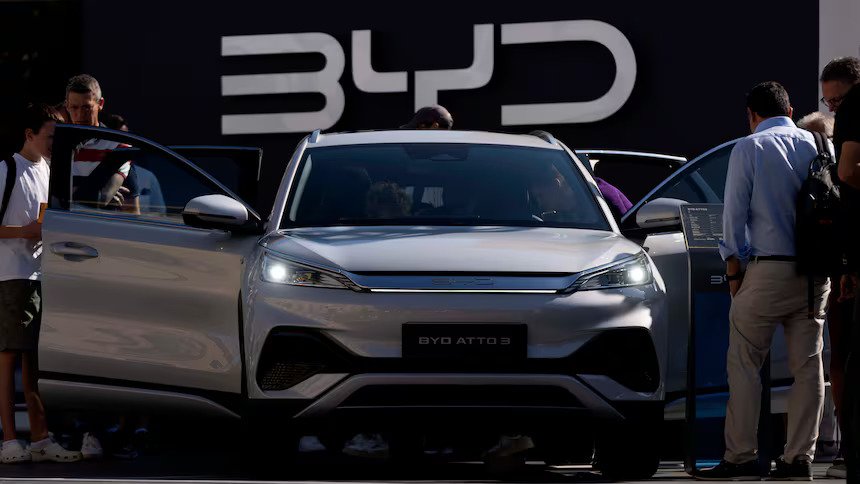
Industry analysts cited in reporting have pointed to Tesla as an early beneficiary because it previously prepared a Canada-specific version of the Model Y for export from its Shanghai plant and already has an established retail and service footprint in Canada. Tesla halted those China-made shipments after the 2024 tariff hike and has been supplying the Canadian market from other factories; the quota system could allow a faster return to China-sourced inventory, depending on how the company chooses to allocate production.:contentReference[oaicite:4]{index=4}
At the same time, the price carve-out underscores why a sudden wave of bargain EVs is not guaranteed. The cheapest models that fit under the threshold may not be the ones already positioned for large-scale Canadian distribution, and brands without Canadian sales networks would still need to navigate regulatory approvals, logistics, after-sales support and marketing before competing nationally at volume.:contentReference[oaicite:5]{index=5}
- Canada’s EV tariff falls to 6.1% within a 49,000-vehicle annual cap, rising over time.:contentReference[oaicite:6]{index=6}
- Half the quota is set aside for vehicles priced under $35,000.:contentReference[oaicite:7]{index=7}
- China is expected to cut canola seed tariffs to about 15% by March 1, linked to the EV move.:contentReference[oaicite:8]{index=8}
Ontario’s warning: jobs and U.S. market access
Ontario Premier Doug Ford, whose province is home to much of Canada’s auto assembly and parts production, has been among the most outspoken critics. He has argued Ottawa is effectively inviting a “flood” of lower-cost Chinese vehicles without firm commitments to invest in Canadian factories or supply chains.:contentReference[oaicite:9]{index=9}
The concerns extend beyond domestic competition. Reporting has noted that relaxing EV tariffs diverges from U.S. policy and has drawn criticism from figures in the Trump administration ahead of an expected review of the North American trade pact. For Canada’s auto sector — deeply integrated with U.S. production and reliant on cross-border shipments — the fear is that any perception of Canada as a back door for Chinese EVs could invite retaliatory measures or harder negotiating lines from Washington.:contentReference[oaicite:10]{index=10}
U.S. Trade Representative Jamieson Greer has publicly described Canada’s decision as “problematic,” warning Canada could regret the move over time. U.S. President Donald Trump, meanwhile, has said Canada is entitled to pursue its own trade arrangements, describing the deal with Beijing as something Canada “should” do if it can secure one.:contentReference[oaicite:11]{index=11}
Prairie pressure and the trade-off Ottawa is betting on
Ottawa’s argument is that the EV concessions are paired with tangible gains for Canadian agriculture and seafood exporters, particularly at a moment when some producers have faced steep Chinese duties. Under the agreement described by Carney, Canada expects China to lower tariffs on canola seed from 84 per cent to a combined rate of about 15 per cent by March 1. Canada also expects certain “anti-discrimination” tariffs affecting canola meal, lobster, crab and peas to be removed from March 1 until at least the end of the year.:contentReference[oaicite:12]{index=12}
The canola stakes are significant because Chinese actions have already disrupted shipments. China’s import halt last fall and its anti-dumping investigation tightened the squeeze on exporters and, in turn, reverberated across Prairie farm incomes and grain handling systems. In recent days, traders reported that a Chinese importer purchased a Panamax cargo — about 60,000 metric tonnes — of Canadian canola, the first such deal since imports were halted in October, with shipping expected after March. A final ruling in China’s anti-dumping investigation is expected before March 9.:contentReference[oaicite:13]{index=13}
Background: from tariff wall to tariff swap
The shift marks a sharp reversal from 2024, when Canada imposed a 100 per cent tariff on Chinese-made EVs, mirroring a broader hardening among Western allies over claims of heavy state support for Chinese manufacturing. After that move, China responded with tariffs on more than $2.6 billion worth of Canadian farm and food products and later levied duties on canola seed, escalating a dispute that affected exporters across the country.:contentReference[oaicite:14]{index=14}
Carney’s China trip — the first visit by a Canadian prime minister to Beijing in nearly a decade — has been portrayed as an attempt to thaw ties and reduce Canada’s reliance on the U.S. market at a time when the Trump administration has applied trade pressure on Canadian industries. Analysts have pointed out that Canada sends the bulk of its exports to the United States, making diversification appealing in theory but politically fraught in practice.:contentReference[oaicite:15]{index=15}
Security and optics: Kovrig urges caution
Michael Kovrig, the former diplomat detained in China for more than 1,000 days, has urged Canadians to treat the shift as a recalibration — not a reset — and to judge success by what follows in policy and protections. In a broadcast interview, he argued Canada needs to expand expertise on China and strengthen safeguards even as it pursues selective trade gains. He also cautioned against steps that could “hollow out” the auto sector, warning that dropping barriers too far, too fast could be devastating for workers and the industrial base tied to vehicle production.:contentReference[oaicite:16]{index=16}
In another interview excerpt circulating online, Kovrig criticized the tone and imagery around the visit, including the risk of appearing overly deferential, and characterized some of the messaging as worrisome.:contentReference[oaicite:17]{index=17}
What happens next
Several key timelines will shape whether Ottawa’s bet pays off:
First, implementation details for the EV quota — including how pricing thresholds are verified and how import allocations are managed — will determine which manufacturers can realistically compete and how quickly vehicles arrive in Canadian showrooms.:contentReference[oaicite:18]{index=18}
Second, the agricultural side of the deal is expected to move on a near-term schedule. Ottawa has said it expects canola seed tariffs to drop to about 15 per cent by March 1, and reporting on commodity markets suggests buyers are already positioning for that change. China is also expected to finalize its anti-dumping decision before March 9, a ruling that could either reinforce or undermine confidence that the détente will hold through the 2026 shipping season.:contentReference[oaicite:19]{index=19}
Third, Canada’s posture toward Washington will remain a defining variable. U.S. officials have signalled discomfort with the tariff rollback, and Canada faces an environment where trade decisions are increasingly read through a geopolitical lens. How Ottawa explains safeguards — and how the U.S. chooses to respond — may matter as much as the number of vehicles that ultimately enter under the quota.:contentReference[oaicite:20]{index=20}
For Canadians, the stakes extend beyond the price of a new car. The debate touches the country’s ability to protect high-wage manufacturing, keep Prairie exports flowing, and navigate a world where trade policy is now tightly bound to national security and alliance politics.:contentReference[oaicite:21]{index=21}