
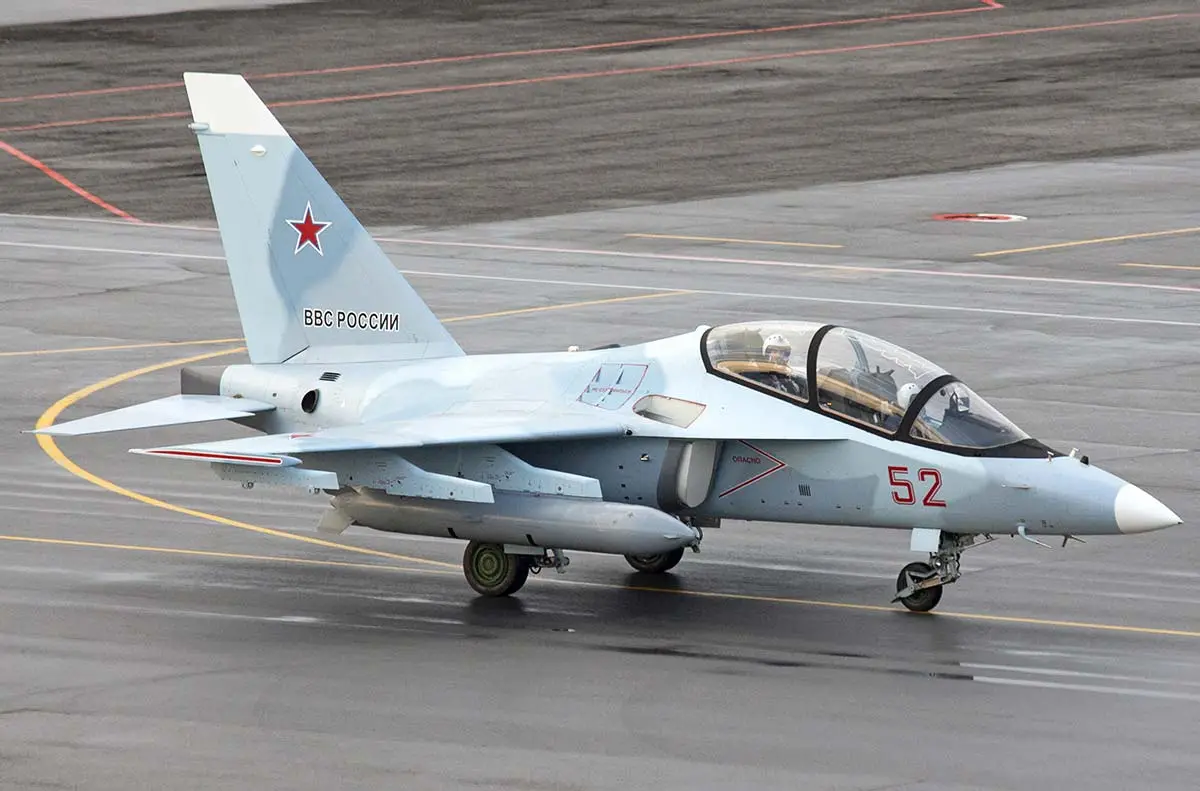
The Yakovlev Yak-130, a Russian advanced jet trainer and light combat aircraft, entered operational service in 2009.
Development and Capabilities
The Yak-130 was developed jointly by Russia’s Yakovlev and Italy’s Aermacchi in the early 1990s to replace aging Soviet-era trainers. It made its maiden flight in April 1996 and was formally introduced to the Russian Air Force in 2010, following extensive flight testing and evaluation.
The aircraft serves as both an advanced trainer and a light combat platform. It can mimic the flight characteristics of multiple fourth-generation and fifth-generation fighters, including Russia’s Sukhoi Su-57. The Yak-130 features tandem seating for two pilots, fly-by-wire controls, and a digital cockpit with multifunctional displays. It is powered by two turbojet engines enabling high manoeuvrability, with angles of attack up to 40 degrees.
It carries a combat payload of up to 3,000 kg across nine external hardpoints, allowing it to be equipped with air-to-air missiles, bombs, reconnaissance pods, and countermeasures. The aircraft can also operate from unprepared airfields, thanks to features such as closable air intakes.
Operational Use and Export
The Yak-130 replaced older trainers like the Aero L-29 and L-39 in Russian service. The Russian Air Force initially ordered 12 aircraft in 2002, expanding to 300 units by 2015. Deliveries continued through to 2015, with training operations commencing in 2013. The aircraft has also been adopted by the Algerian, Bangladeshi, Belarusian, Iranian, Libyan, Vietnamese, and Kazakh air forces.
The export success is partly due to the Yak-130’s versatility and cost-effectiveness. It is marketed not only as a trainer but also as a light attack aircraft, appealing to countries requiring multi-role capabilities within constrained budgets.
The strategic importance and export impact of the Yak-130 were highlighted by defence analyst Ivan Petrov, who noted the aircraft’s “balance of advanced training features with combat functionality, making it a unique asset for emerging air forces.” The relevance of this view is underscored in a recent tweet by Petrov on the aircraft’s expanding role:
Technical and Operational Challenges
Despite its success, the Yak-130 has experienced some setbacks. A crash in 2014 near Akhtubinsk raised concerns about operational safety, though the Russian Ministry of Defence continued deliveries and training with the type. The aircraft’s advanced digital avionics suite, developed by Russia’s KRET, was tested in 2014 to enhance situational awareness and targeting capabilities.
Efforts are ongoing to develop upgraded versions, such as the Yak-130M, which aims to improve performance and avionics further, with development expected to continue into the late 2020s.
Context and Background
The Yak-130’s origins lay in the post-Soviet need to modernise pilot training. After the Soviet Union’s collapse, Russian military aviation sought to replace Czech-made L-29 and L-39 trainers with a more advanced type. The joint development with Italy’s Aermacchi ended in 2000 due to differing priorities, resulting in two separate aircraft: the Yak-130 and Italy’s M-346.
The Yak-130’s ability to replicate multiple fighter profiles, including stealthy and highly manoeuvrable jets, allows pilots to train on one platform before transitioning to frontline combat aircraft. This reduces training costs and complexity.
Production takes place at the Sokol Aviation Plant in Nizhny Novgorod, Russia. The Russian Air Force continues to view the Yak-130 as a vital asset for pilot training and light attack roles.