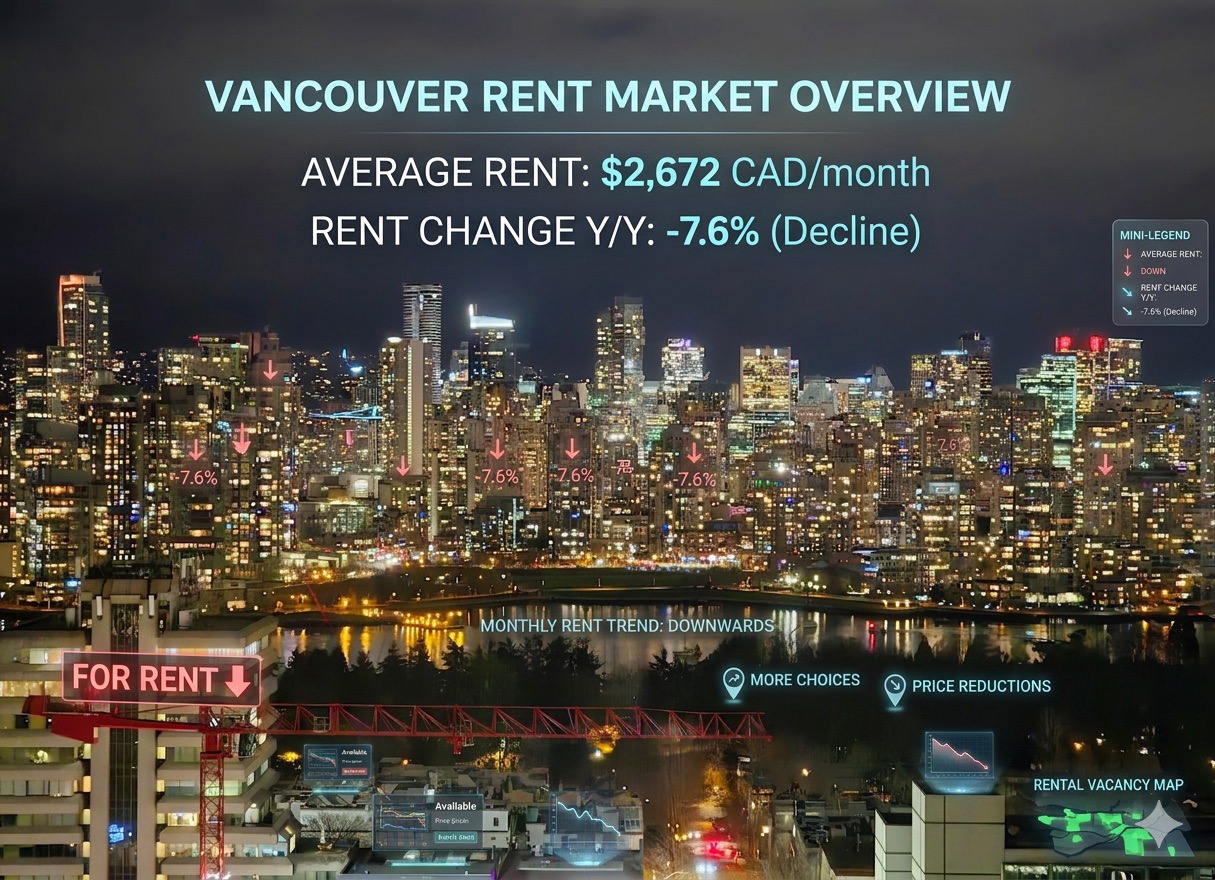
Rental prices in Vancouver have fallen over the past year as a surge in housing supply begins to cool one of the country’s most expensive markets.

The average rent in the city sat at $2,672 in February, representing a nearly six per cent decrease compared to the same month in 2025.
Giacomo Ladas, a spokesperson for Rentals.ca, said the decline is linked to a multi-decade high in available units.
“There is just a lot of new-purpose rentals being built,” Ladas said.
Despite the drop, Vancouver remains significantly more expensive than the national average of approximately $2,030.
The market is reacting.
A shift in the housing market
Data from a recent report by Rentals.ca and Urbanation suggests the cooling trend is not limited to Vancouver’s downtown core, though prices in the region still lead the country.
North Vancouver currently holds the title of Canada’s most expensive rental market, with an average price of $2,926.
Other Lower Mainland cities dominate the top five priciest locations in the country, including Richmond at $2,558, Burnaby at $2,511, and Coquitlam at $2,491.
The following table outlines the average rental costs in the most expensive B.C. markets as of February 2026, according to Rentals.ca.
| City | Average Rent (Feb 2026) | National Rank |
|---|---|---|
| North Vancouver | $2,926 | 1 |
| Vancouver | $2,672 | 2 |
| Richmond | $2,558 | 3 |
| Burnaby | $2,511 | 4 |
| Coquitlam | $2,491 | 5 |
Why prices are cooling
The influx of supply is being driven by a combination of new construction and a shift in the real estate sales market.
Ladas noted that many units currently on the rental market were not originally intended for tenants.
“There is a flood of condos that are now being placed on Rentals.ca for rent that were originally built and developed to sell, and then when they became available, they just weren’t being bought, so they are now in place as rental stock,” Ladas said.
When these units failed to find buyers in the current economic climate, developers and individual owners opted to list them as rental stock instead.
Supply increased.
The report also found that rents in Vancouver have reached their lowest levels since early 2022, marking a significant correction after years of rapid growth.
Regional variations across British Columbia
While Vancouver saw a notable decline, other B.C. cities experienced even sharper drops in asking prices, according to data from Zumper, a digital marketplace for renters.
Kelowna recorded the largest year-over-year decrease in the country for one-bedroom apartments, with the median price falling 11.9 per cent to $1,700.
Burnaby and Victoria also saw significant movement for larger units, with two-bedroom suites in both cities dropping 7.3 per cent compared to last March.
In Vancouver, the median price for a one-bedroom rental was $2,390 in March, down 1.2 per cent from the previous year.
Two-bedroom apartments in the city saw a more pronounced dip, with the average asking price of $3,280 representing a six per cent decrease.
Abbotsford also joined the list of the top 20 most expensive markets for renters in Canada, highlighting the continued high cost of living across the province.
National trends and local realities
On a national scale, the rent index has remained negative for 17 consecutive months, but the pace of those declines appears to be slowing.
The average one-bedroom rent across Canada is down 3.8 per cent to $1,779, while two-bedrooms dropped 3.9 per cent to $2,197.
A report from Zumper suggested the national market may be reaching a point of stability.
“These trends suggest the sharpest phase of the correction may be behind us and that the national market appears to be stabilizing as the spring leasing season approaches,” the report stated.
While B.C. markets cool, other regions are seeing prices climb.
In Ontario, Kingston saw a sharp 15.6 per cent jump in one-bedroom asking prices, while Halifax and Saskatoon experienced rises of 5.3 per cent and 4.8 per cent, respectively.
Experts note that smaller markets with fewer listings tend to experience greater price volatility than major urban centres.
Vancouver remains an outlier.
The correction continues.