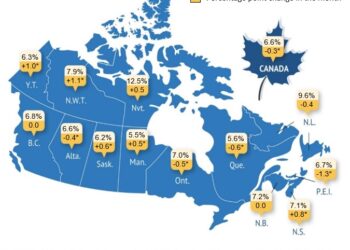

Canada’s economy shed 84,000 jobs in February, pushing the national unemployment rate up to 6.7% as a sharp contraction in full-time private sector employment offset previous gains and defied economist forecasts of modest growth.
According to the Statistics Canada Labour Force Survey released Friday, the 0.4% decline in employment pulled the employment rate down 0.2 percentage points to 60.6%. The results were significantly weaker than the 10,000-job gain predicted by a Reuters poll of economists, who had also expected the unemployment rate to rise more slowly than the two-tick increase recorded. The downturn was led by the loss of 108,000 full-time positions, a 0.6% decline that erased gains made in the preceding two months. The following table outlines the primary shifts in the Canadian labour market for February 2026:
| Indicator | February 2026 Value | Monthly Change |
|---|---|---|
| Total Employment | -84,000 | -0.4% |
| Unemployment Rate | 6.7% | +0.2 pts |
| Full-Time Employment | -108,000 | -0.6% |
| Private Sector Employees | -73,000 | -0.5% |
| Participation Rate | 64.9% | -0.1 pts |
| Average Hourly Wage | $37.56 | +3.9% (YoY) |
This is clearly a very worrisome report for the [Bank of Canada] that shows that labour market slack has increased and activity is frozen amidst trade uncertainty.
The quote above from Katherine Judge, executive director and senior economist at CIBC Capital Markets, highlights the pressure on the central bank ahead of its March 18 interest rate decision. The pullback in hiring is increasingly attributed to external economic pressures. Wilson Cross, CEO and Co-Founder of Borderless AI, noted that companies have entered a “wait-and-see” mode. “Following increasing global tensions, market volatility, and renewed tariff discussions with the U.S., the economic environment is no longer stable; many companies are halting expansion plans, including hiring,” Cross said.
Demographic and Sectoral Impact
The job losses were concentrated among younger workers and core-aged men. Employment for youth aged 15 to 24 fell by 47,000, a 1.7% decline, while the youth unemployment rate rose to 14.1%. Statistics Canada noted that jobless rates for racialized youth remained notably higher than for non-racialized peers. Men in the core working age of 25 to 54 saw a decrease of 41,000 positions, a 0.6% drop. Brendon Bernard, senior economist at Indeed, observed that the weakness in youth employment represents a return to September levels, suggesting that strength seen at the end of 2025 may have been an outlier. Global News provided further analysis on the challenges facing young job seekers in the current economic climate:
Industry-wide, the losses were broad-based, with only three of 16 sectors adding workers. Services-producing industries shed 56,000 jobs, while goods-producing industries lost 28,000. Key sectoral declines included:
- Wholesale and retail trade: -18,000 positions (-0.6%)
- Other services (including personal care and repair): -14,000 positions
- Construction and manufacturing: Notable declines (data not specified)
- Transportation and warehousing: +10,000 positions
- Public administration: +8,100 positions
Regional Divergence
Quebec experienced its most significant employment contraction in over four years, losing 57,000 jobs. This pushed the provincial jobless rate up 0.7 percentage points to 5.9%. British Columbia shed 20,000 positions, while Saskatchewan and Manitoba also reported losses. In contrast, employment in Ontario remained steady, though the province saw 28,000 additional people begin looking for work, partially recovering from a dip in participation caused by severe winter weather in January.
Despite the cooling labour market, wage growth remained elevated. Average hourly wages rose 3.9% year-over-year to $37.56, an increase of $1.42. However, the overall softness of the report, characterized by a second consecutive monthly decline in private sector roles, suggests a genuine cooling in labour demand. Bernard noted that the rise in the unemployment rate may actually understate the market’s weakness because it occurred alongside a declining participation rate, which has fallen 0.4 percentage points over the last 12 months.