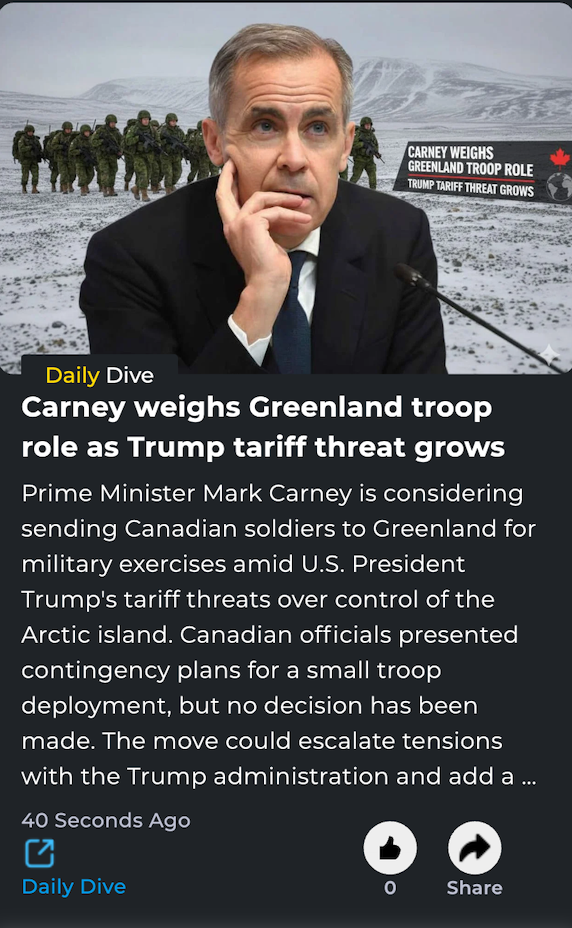
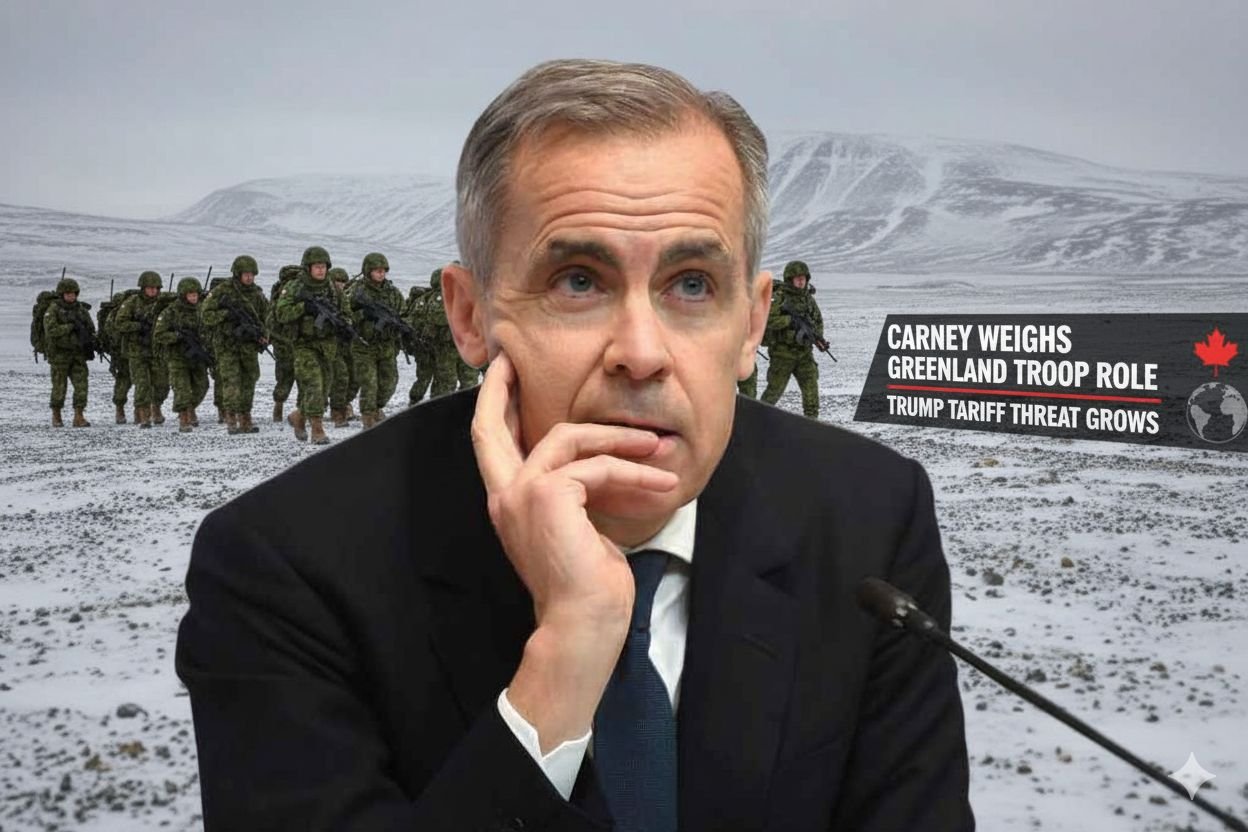
OTTAWA — Prime Minister Mark Carney is considering whether Canada should send soldiers to Greenland for military exercises alongside allies, as U.S. President Donald Trump threatens new tariffs against European countries unless they agree to a deal that would give Washington control of the Arctic island.
Two senior Canadian officials said contingency plans were presented to the federal government last week, including an option to deploy a small contingent of Canadian soldiers to Greenland on short notice. The officials said a decision has not been made and warned the political risk of joining a Danish-led exercise could trigger blowback from the Trump administration.
The possible move would add a Canadian military dimension to a rapidly escalating dispute that has blended security questions in the Arctic with trade pressure aimed at Europe. Trump has publicly tied tariff threats to his demand that the United States be allowed to “buy” or otherwise control Greenland, an approach European governments have rejected as interference in sovereignty decisions.
Ottawa weighs a larger role in Greenland
Canadian officials said a Royal Canadian Air Force contingent is already participating in a pre-planned NORAD exercise in Greenland. Carney is now weighing whether to send additional personnel to take part in Danish-planned sovereignty exercises that could include drills focused on protecting critical infrastructure on the island.
The officials said that while the countries involved are members of NATO, the proposed Danish exercise would sit outside the alliance’s formal framework, making it more akin to ad hoc coalitions that have formed around specific security challenges in recent years. That distinction matters politically, they said, because it could be read in Washington as a direct response to Trump’s Greenland demands rather than routine NATO activity.
Speaking in Doha, Qatar, Carney said Canada is “concerned” by Trump’s tariff threats and that Canada supports “sovereignty and territorial integrity.” Carney added that decisions about Greenland’s future should be made by Greenland and Denmark.
- Canada is weighing whether to send a small troop contingent to Greenland for military exercises alongside allies.
- Trump has threatened tariffs on several European countries unless they agree to a Greenland deal.
- European leaders are discussing a collective economic response mechanism designed to counter coercive trade pressure.
Tariffs tied to a geopolitical demand
Trump has threatened an additional 10 per cent tariff on goods from Denmark, Norway, Sweden, France, Germany, the Netherlands, Finland and the United Kingdom starting Feb. 1. He has said the tariff would rise to 25 per cent on June 1 if those countries continue to resist his push to gain control over Greenland.
European officials have argued that the threat is different from traditional trade disputes because it explicitly links tariff pressure to a geopolitical outcome: forcing European governments to accept U.S. demands involving Greenland. Some European governments have described that approach as economic blackmail and have said they will not change their position under tariff pressure.
The tariff threat also comes on top of existing trade friction. European officials note that the European Union currently faces a 15 per cent U.S. tariff that was negotiated down from a much larger threatened rate in the summer of 2025 during talks led by European Commission President Ursula von der Leyen.
Europe looks at an “economic Article 5”
As Washington’s Greenland-linked tariff threats intensify, European capitals are discussing whether to use the European Union’s Anti-Coercion Instrument — a never-used tool that entered into force in late December 2023. The mechanism is designed to give the bloc a collective response when a member state is pressured into making a particular choice through measures affecting trade or investment.
Even though Greenland is not a member of the European Union, European officials have pointed to Denmark’s role in the territory and argued that coercion aimed at Greenland can function as coercion aimed at an EU member’s sovereign decision-making. In that sense, they frame the tool as a trade equivalent of NATO’s Article 5 principle — an attack on one treated as an attack on all — except that the response would be economic rather than military.
Under the process set out in the law, the European Commission can open an examination on its own initiative or at the request of a member state. The Commission then assesses the alleged coercion over a period generally not exceeding four months. If it concludes coercion exists and proposes action, EU member states would then have a limited window — roughly two months, with timelines laid out in weeks — to determine formally that coercion is taking place and to authorize a response path.
Only after that, European officials say, would the bloc move to “last resort” measures intended to induce the third country to stop. Those measures can include restricting access to the EU market and other economic disadvantages across goods, services, investment, public procurement, financial markets, trade-related intellectual property and export controls. The framework also anticipates that any response would be terminated once coercive measures end.
Background: why Greenland is at the centre of a wider fight
The dispute has put Greenland — a vast Arctic territory that is politically linked to Denmark — at the centre of a broader confrontation over sovereignty, alliance cohesion and the use of trade measures to compel political outcomes. Trump has repeatedly argued that the United States needs Greenland for strategic reasons and has suggested Washington should be able to purchase or control the territory, even as European governments insist the decision belongs to Greenland and Denmark.
For Canada, the question is not only diplomatic but operational. Canada’s military relationship with the United States in the Arctic runs through NORAD, and Canadian officials say Canada is already active in the region through planned exercises. The new question is whether Canada should expand its role by joining a Danish-led exercise aimed at demonstrating sovereignty and readiness — and whether doing so could sharpen tension with Washington at a moment when Trump is explicitly using tariffs as leverage against allies.
European leaders have responded by closing ranks publicly around Denmark and Greenland’s right to determine their own future, while simultaneously debating how to deter what they describe as coercive tariff threats without triggering an escalating trade confrontation.
What happens next
Canadian officials say one option under consideration would see a small contingent of Canadian soldiers flown to Greenland by the end of the week if called upon, though they stress the government has not finalized a decision. Carney’s government is weighing the security signal that participation would send against the risk that it could further strain relations with the Trump administration.
On the trade front, Trump’s stated timeline sets Feb. 1 as the start date for the proposed additional 10 per cent tariffs on goods from the listed European countries, with a scheduled increase to 25 per cent on June 1 if no Greenland-related deal is reached. European officials, meanwhile, are debating whether to pursue dialogue first or begin the formal steps that could lead to an Anti-Coercion Instrument response — a process that, by design, unfolds over months rather than days.
In the days ahead, Canada’s choice on whether to join a Greenland exercise will be read closely by allies and by Washington. For Canadians, the episode underscores how quickly Arctic security concerns can collide with trade policy — and how disputes far from Canada’s shores can still shape the country’s defence posture, alliances and economic risk at home.