TORONTO — U.S. authorities say Ryan Wedding, a former Canadian Olympic snowboarder who investigators allege led a violent cross-border cocaine trafficking network, was arrested in Mexico on Thursday night and is being transported to the United States to face prosecution.
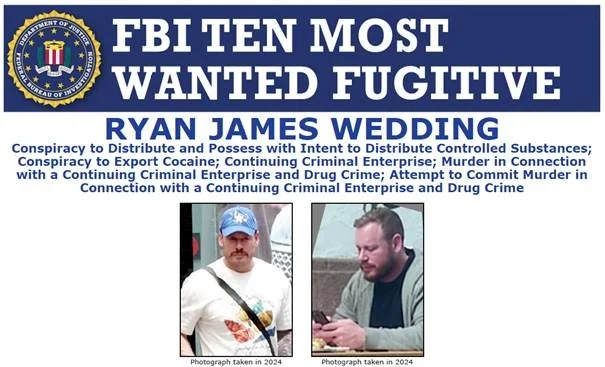
U.S. Attorney General Pam Bondi and FBI Director Kash Patel confirmed the arrest in social media posts on Friday, according to information later reported by U.S. officials. Patel said Wedding was apprehended in Mexico after being sought as one of the FBI’s Ten Most Wanted Fugitives and was being moved to the U.S.
Mexican Security Secretary Omar García Harfuch wrote on social media that Patel met with Mexican counterparts on Thursday and left the country with two detainees. García Harfuch said one of the detainees was a Canadian citizen who turned himself in at the U.S. embassy, while another was a separate person who had been detained by Mexican authorities. A member of Mexico’s security cabinet later identified Wedding as the Canadian who surrendered at the embassy.
Wedding, 44, competed for Canada at the 2002 Winter Olympics in Salt Lake City. Authorities allege that, years later, he became a central figure in a multinational drug enterprise moving cocaine through Mexico and the United States and into Canada, using violence and intimidation to protect the operation.
Allegations span drug trafficking and killings
In a U.S. Department of Justice announcement in November, prosecutors alleged Wedding oversaw a continuing criminal enterprise that shipped large quantities of cocaine from Colombia through Mexico and Southern California, with deliveries also destined for Canada and other U.S. locations. The department said investigators believe Wedding worked closely with the Sinaloa Cartel and used associates and intermediaries to insulate himself while directing major drug shipments.
That same U.S. announcement described “Operation Giant Slalom” as an international investigation involving American, Canadian and Colombian partners. Ten defendants were arrested in that phase of the case, including several people taken into custody in Canada in communities across Ontario, Quebec and Alberta. U.S. officials alleged the group included facilitators who helped locate a federal witness and enabled a killing in Colombia.
U.S. prosecutors allege Wedding ordered murders to advance the enterprise’s interests. The Justice Department said a cooperating witness in a separate U.S. narcotics case was shot and killed in a restaurant in Medellín, Colombia, on Jan. 31, 2025, after Wedding allegedly offered a bounty and enlisted others to track the person down.
Authorities also allege the witness was identified using an online posting. In the November announcement, the U.S. government said a website operator agreed, for payment, not to post about Wedding and instead posted a photograph of the witness so the person could be located and killed.
In Canada, Wedding has also been linked by U.S. prosecutors to alleged violence in Ontario. The Justice Department said a 2024 indictment accused Wedding of directing the Nov. 20, 2023 murders of two members of a family in Caledon, Ont., in retaliation for a stolen drug shipment that had passed through Southern California. Prosecutors said another family member survived but suffered serious physical injuries.
Wedding has not been convicted of the allegations described by U.S. authorities. Criminal charges are allegations that must be proven in court.
- U.S. officials say Wedding was arrested in Mexico on Thursday night and is being transported to the United States.
- Investigators allege Wedding led a transnational cocaine trafficking enterprise linked to the Sinaloa Cartel.
- U.S. prosecutors allege the enterprise used intimidation and killings, including the 2025 murder of a federal witness in Colombia.
- U.S. officials say Wedding also faces separate drug trafficking charges in Canada dating back to 2015.
Background: a widening cross-border investigation
Wedding was added to the FBI’s Ten Most Wanted list in March 2025, with the FBI describing him as a Canadian national born in Thunder Bay, Ont., whose aliases included “El Jefe,” “Giant,” “Public Enemy,” “James Conrad King,” and “Jesse King.” At the time, the U.S. State Department offered a reward of up to US$10 million for information leading to his capture.
By November 2025, U.S. officials said the reward had increased to US$15 million, and the Justice Department publicly detailed what it called the second phase of Operation Giant Slalom. That announcement named Canadian and international suspects alleged to have supported the enterprise’s violent enforcement and efforts to evade extradition.
The Justice Department said Wedding had been residing in Mexico and that law enforcement continued to search for him as of November, along with other defendants alleged to be in Canada, Mexico and the Dominican Republic.
For Canadian authorities, the case has been framed as a test of international coordination against organized crime networks that move drugs across borders and rely on partners in multiple countries. RCMP Commissioner Mike Duheme said in the November statement that international cooperation and information sharing are central to targeting organized crime groups regardless of where they operate.
What happens next
U.S. officials said Wedding is being transported to the United States, where he is expected to face proceedings in federal court. Patel was expected to hold a news conference later Friday in California, with earlier announcements indicating Canadian law enforcement leaders would also participate.
U.S. prosecutors have alleged Wedding led a continuing criminal enterprise and engaged in witness intimidation tactics, including murder. In the November announcement, the Justice Department said that if convicted on charges tied to the witness killing, Wedding and others charged in that portion of the case would face a maximum sentence of life in federal prison.
Canadian legal exposure may also remain. U.S. officials have said Wedding faces separate drug trafficking charges in Canada dating back to 2015, though Canadian court proceedings and timelines would depend on decisions by prosecutors and the status of any U.S. extradition or transfer process.
For Canadians watching the case, the arrest underscores how alleged drug supply routes and violence tied to organized crime can stretch from Latin America to U.S. distribution hubs and into Canadian communities—drawing in police services and courts on both sides of the border.