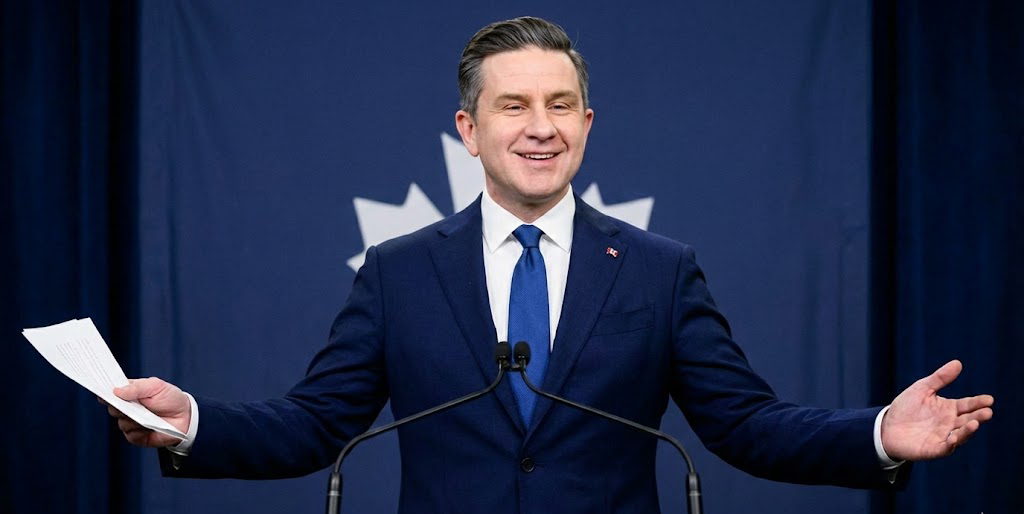
CALGARY — Conservative delegates are gathering in Calgary this weekend for the party’s national convention, where they are set to vote on whether Pierre Poilievre should remain leader — a review triggered by the party’s loss in April’s federal election and the first such delegate vote in about two decades.
The leadership review is expected to be a focal point of the convention, which draws Conservatives from across the country for speeches, internal party business and strategy-setting ahead of the next campaign.
Poilievre’s leadership is up for a mandatory review after the Conservatives failed to form government in April, losing the election to the Liberals.
A vote that has been rare in modern Conservative politics
Delegates are voting on whether Poilievre should remain at the helm — a decision that, by the party’s recent history, is unusual to see put to a national convention floor.
The last time Conservatives held a comparable leadership vote was in 2005, when Stephen Harper won the support of 84 per cent of delegates even though he had not defeated the Liberals in the 2004 election.
That precedent is shaping expectations heading into Calgary. Observers cited in reporting on the convention have suggested Poilievre is widely expected to survive the review, shifting attention to the message he delivers to party members once the result is known.
- Conservatives are holding their national convention in Calgary this weekend.
- Delegates are set to vote on whether Poilievre should remain leader after the party lost April’s election.
- The last comparable leadership vote was in 2005, when Harper won 84 per cent support from delegates.
What Poilievre says next may matter as much as the vote
With the leadership review hanging over the convention, much of the political focus is on what Poilievre will say to party faithful once he takes the stage.
Ian Brodie, a University of Calgary political science professor and former chief of staff to Harper, said Poilievre’s Friday speech offers a chance to set the tone for the strategy he intends to carry into the next election.
That framing reflects a broader reality for parties after an election loss: even when a leader secures enough internal support to continue, convention weekends often become a public test of unity, discipline and direction — especially when delegates have just been asked to decide whether the leader should stay.
Background: why the review is happening now
The review is taking place because the Conservatives lost April’s federal election to the Liberals, which automatically put Poilievre’s leadership up for a mandatory assessment by convention delegates.
In practical terms, that means the convention is not only about policy debates and party organization; it is also a moment for Conservatives to weigh how they want to position themselves after an election defeat and how they want their leader to present that plan to Canadians.
The rarity of the vote adds weight to the outcome. The last time Conservatives held a comparable delegate vote on a leader’s future, Harper won a strong endorsement in 2005 — a benchmark that remains a reference point for how party members may interpret the strength of a leader’s mandate after a loss.
What happens next
Delegates’ decision on Poilievre’s leadership is expected to be followed closely by his address to convention attendees on Friday, which is being watched as an early signal of how he plans to rally the party and sharpen its pitch for the next election.
Beyond the leadership review itself, the convention weekend in Calgary is also a chance for Conservatives from different regions and factions to align on priorities and messaging — a crucial step for any party that is trying to turn an election loss into a return-to-power strategy.
For Canadians, the leadership vote and the tone Poilievre sets in its aftermath matter because they will shape how the Official Opposition approaches the Liberal government in Parliament and how Conservatives frame the choices voters face in the next national campaign.