
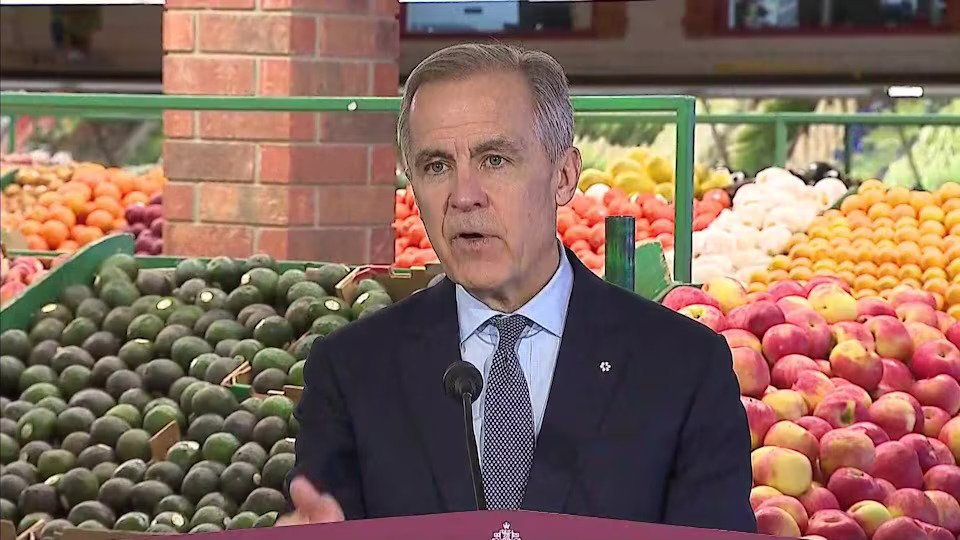
OTTAWA — Prime Minister Mark Carney says millions of Canadians will receive more money through the federal GST credit, unveiling what his government is branding as the “Canada Groceries and Essentials Benefit” as Parliament returns and affordability remains a central political pressure point.
Carney announced Monday that Ottawa will raise the existing GST credit amount by 25 per cent and deliver a one-time payment “equivalent to 50 per cent of the GST credit this year.” He said the change is meant to help with the cost of groceries and essentials, and would put “hundreds of dollars more” into the accounts of more than 12 million Canadians.
Carney also offered illustrative figures for households already receiving the credit. He said a family of four currently receives about $1,100 a year through the existing GST credit. With the new benefit, he said that same family would receive up to $1,890 this year and about $1,400 a year for each of the next four years.
Carney did not specify eligibility criteria for the new benefit beyond tying it to the existing GST credit system.
Beyond the credit: food security and competition measures
Alongside the GST credit changes, Carney said Ottawa is launching a new National Food Security Strategy aimed at “root causes” of food insecurity and affordability. He said the strategy will include unit label pricing, which he described as a way to help Canadians compare products more easily.
Carney said the strategy will also support the Competition Bureau in “monitoring and enforcing competition in our market,” and will include measures meant to strengthen food security in Canada’s North.
He said the federal package includes a $20 million top-up for food banks, and that Ottawa will invest $500 million into a fund intended to help food businesses expand and strengthen their supply chains.
- GST credit increase of 25 per cent, plus a one-time top-up this year
- National Food Security Strategy that includes unit label pricing
- Support for competition enforcement and measures focused on the North
- $20 million top-up for food banks and $500 million supply-chain fund for food businesses
Political reaction: Conservatives call for different approach
The Conservative Party said the measures would not solve what it described as Canada’s cost-of-living crisis. In a written statement, Conservative MPs Sandra Cobena and Vincent Ho argued that the government should instead repeal what they called the “food inflation packaging tax,” the industrial carbon tax and the fuel standard, warning the fuel standard would add 17 cents per litre of gas and increase costs across the food supply chain.
Government House Leader Steve MacKinnon, speaking after the prime minister, challenged Conservative Leader Pierre Poilievre to support the measures when the legislation comes up for a vote in the spring session.
MacKinnon pointed to a letter Poilievre sent to Carney on Saturday under the subject line “Time to turn rhetoric into reality,” in which Poilievre said he was offering to help fast-track policies related to trade, affordability, bail reform and major project approvals. MacKinnon said Poilievre would have an opportunity to back Carney’s newly announced affordability package in Parliament.
Background: a familiar affordability lever with a new label
Carney’s plan centres on increasing an existing federal credit rather than creating an entirely new program. The GST credit is already used to deliver targeted tax relief, and Carney’s approach repackages that mechanism under a new name tied directly to groceries and essentials.
In announcing the measures, Carney framed the changes as immediate financial help for households while a broader food security strategy is developed. The measures touch on consumer-facing tools like unit label pricing, enforcement tools focused on competition, and targeted supports such as food bank funding, alongside the larger dollar figures attached to the GST credit changes and supply-chain investment fund.
Even as Carney highlighted the scale of the benefit — more than 12 million Canadians, by his estimate — the lack of detail about eligibility parameters left key questions unanswered for many households that do not currently receive the GST credit and want to know whether they would qualify under the rebranded program.
Trade and tariffs intrude on the affordability message
Carney’s affordability announcement also unfolded under the shadow of rising Canada-U.S. trade tension, after he was asked about U.S. President Donald Trump’s threat of steep tariffs and a personal jab aimed at the prime minister.
Carney said he would not respond to every online comment, adding: “I can handle it.”
Carney was responding after Trump referred to him as “Governor Carney,” a label Trump previously used for former prime minister Justin Trudeau. Carney was also asked about Trump’s warning of 100 per cent tariffs on Canada, and about a Trump post threatening such tariffs if Canada made a deal with China.
The federal minister responsible for Canada-U.S. trade and one Canadian economy, Dominic LeBlanc, has said Ottawa is not pursuing a free trade deal with China, describing recent talks instead as an effort to resolve specific tariff-related issues.
The exchange underscored the political challenge facing Carney as he tries to focus on household affordability while managing an unpredictable trade backdrop that can quickly affect prices, supply chains and business confidence.
What happens next
Carney’s GST credit expansion and the one-time top-up will require legislation, setting up a spring session debate that MacKinnon has already framed as an early test of whether Conservatives will support or oppose the package.
In the near term, Canadians who already receive the GST credit will be watching for details on timing and eligibility — particularly since Carney said the one-time payment would be delivered this year, and the larger benefit is described in multi-year terms. Carney’s office and the government’s parliamentary agenda will face pressure to clarify how the “Canada Groceries and Essentials Benefit” will be administered and who will qualify.
More broadly, the promised National Food Security Strategy — with its unit label pricing initiative, competition enforcement focus and measures aimed at the North — signals further policy work ahead beyond the GST credit changes. The government’s commitments on those fronts will likely be scrutinized for whether they can meaningfully change conditions in the grocery sector or primarily provide better information and enforcement tools.
For Canadians, the week’s debate is likely to land in practical terms: how much relief the expanded credit provides, how quickly it arrives, and whether Ottawa can translate a rebranded benefit and a new strategy into visible, sustained affordability gains at the checkout.