TORONTO — Global markets fell sharply after U.S. President Donald Trump intensified a standoff with European allies over Greenland, reviving fears of a tariff fight and fresh uncertainty inside NATO that investors treated as a new geopolitical risk to trade and financial stability.
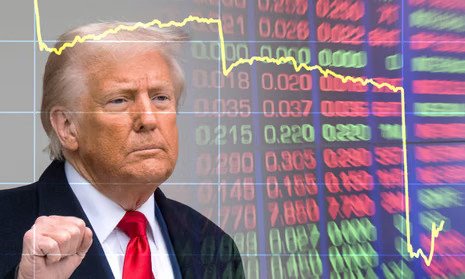
Wall Street’s benchmark S&P 500 dropped nearly 2.1 per cent on Tuesday, while the tech-heavy Nasdaq Composite fell almost 2.4 per cent and the Dow Jones Industrial Average slid about 1.8 per cent. The moves marked Wall Street’s worst day since October, a jolt that rippled across Europe and into early Asian trading.
The U.S. dollar also weakened, falling 0.8 per cent against a basket of major currencies — an unusual move for a currency that often benefits from “safe haven” demand during market stress. Gold climbed nearly 2 per cent to a record high above US$4,700 an ounce, a sign that traders were seeking protection from uncertainty rather than leaning into risk.
European equities ended the day lower, with London’s FTSE 100 closing down about 0.7 per cent and Germany’s DAX falling by more than 1 per cent. In Asia on Wednesday, Japan’s Nikkei 225 and South Korea’s KOSPI both dropped more than 1 per cent in early trading before recouping much of the losses later in the morning.
A dispute over Greenland, and the threat of tariffs
The market selloff followed Trump’s latest push to bring Greenland under U.S. control, an objective he has linked to Arctic security and competition with China and Russia. Trump has threatened Denmark — and seven other European countries — with steep tariffs unless there is a deal to sell the self-governed Danish territory.
The rhetoric has pushed the U.S.-European relationship to what some European leaders have described as its lowest point in decades, raising questions about the resilience of the NATO alliance and the future of transatlantic trade flows at a time when many economies are already grappling with elevated interest rates and slower growth.
Trump has also refused to rule out military force to achieve his aims, despite the United States and Denmark being NATO members. During a briefing at the White House on Tuesday, he was asked how far he would go to acquire Greenland and responded: “You’ll find out.”
Trump travelled to Switzerland for the annual World Economic Forum in Davos and was expected to meet leaders from NATO allies on Wednesday. He has also voiced confidence that a deal on Greenland can be reached, saying “things are going to work out pretty well.”
Europe’s response: sovereignty, unity and a warning on escalation
European Commission President Ursula von der Leyen has said the bloc is prepared to work with Washington to strengthen Arctic security but would not compromise on sovereignty. Speaking at Davos, she described Americans as friends and allies and warned against a spiral of retaliation.
“Our response will be unflinching, united and proportional,” she said.
In Strasbourg on Wednesday, von der Leyen reinforced the political line that Greenland’s future is not for outside powers to decide. “The future of Greenland is only for the Greenlanders to decide,” she said, arguing that Europe needs to adapt to a world “defined by raw power” and develop stronger “levers of power” rather than relying on “traditional caution.” She also urged European leaders not to lose focus on Ukraine.
Beyond statements, the European Union is scheduled to convene an emergency meeting on Thursday to discuss possible responses to Trump’s threats. Among the options under discussion is an anti-coercion mechanism that could enable sweeping restrictions, including measures aimed at large U.S. technology firms operating in the European market.
Diplomatic fallout spreads across capitals
The political dispute has begun to spill into domestic politics and consumer behaviour in Denmark. Danish broadcasters have reported that smartphone apps designed to help shoppers identify products made in the United States are gaining traction as frustrations rise. A mid-2025 survey aired by a Danish broadcaster found that 47 per cent of Danes said they had deliberately refrained from buying American goods as a result of tensions with the U.S. administration.
In the United Kingdom, Prime Minister Keir Starmer reiterated support for Denmark and Greenland while facing questions in Parliament about his recent call with Trump. Starmer said Britain would not yield “on our principles and values” about Greenland’s future under threats of tariffs, and he said Danish Prime Minister Mette Frederiksen is scheduled to visit London on Thursday for talks — a trip coming just hours before the EU’s emergency council meeting in Brussels.
Starmer’s government described the meeting as part of a series of high-level contacts with Denmark this week, underscoring how quickly the Greenland issue has widened into a broader diplomatic test for Washington’s relationships in Europe.
Bessent’s “irrelevant” remark adds to strain
Adding to the tension, U.S. Treasury Secretary Scott Bessent brushed aside concerns about Denmark’s role in the dispute. When asked about Danish investments, he responded that “Denmark’s investment in US treasury bonds, like Denmark itself, is irrelevant.”
For European officials, the remark landed as both dismissive and provocative, arriving at a moment when financial markets were already responding to the risk that political confrontation could be followed by tariffs, countermeasures and uncertainty for companies and investors on both sides of the Atlantic.
Background: why Greenland has become a flashpoint
Greenland’s location and resources have made it increasingly prominent in Arctic strategy discussions, and Trump has framed control of the territory as a security imperative in an era of heightened competition in the region. He has argued that the island matters because of the strategic ambitions of China and Russia in the Arctic, and he has presented ownership as a non-negotiable goal.
Denmark has repeatedly said Greenland is not for sale. Danish leaders have also warned that any attempt to take the island by force would represent a profound breach among allies. The dispute has amplified anxieties about NATO itself, a 32-member alliance built on the principle that an attack against one member is considered an attack against all.
That dynamic helps explain why a territorial argument has sparked market concern: investors tend to react sharply when trade and security relationships between major economic blocs appear to be at risk of rapid deterioration. The sharp drop in U.S. stocks and the shift into gold reflected a broader reassessment of geopolitical stability rather than a change in corporate fundamentals.
What happens next
Attention now turns to Trump’s meetings and public appearance at the World Economic Forum on Wednesday, where European leaders and investors will be watching for any hint of compromise or escalation. Trump’s willingness to pair the Greenland demand with tariff threats has already rattled markets, and traders are likely to react quickly to any new timeline or targets.
On Thursday, European leaders are expected to gather for the emergency meeting on potential responses, including whether to move toward measures under the anti-coercion mechanism. The same day, Frederiksen is expected in London for talks with Starmer, a meeting that will be closely watched as a signal of European solidarity and an attempt to coordinate positions ahead of any formal EU action.
For Canada, the turmoil matters on two fronts: it highlights how quickly political disputes among allies can spill into global markets, and it raises the stakes for NATO cohesion as an Arctic-adjacent country with deep economic ties to both the United States and Europe. As investors digest the latest headlines, the immediate question is whether the next 48 hours bring steps toward de-escalation — or new triggers for volatility.