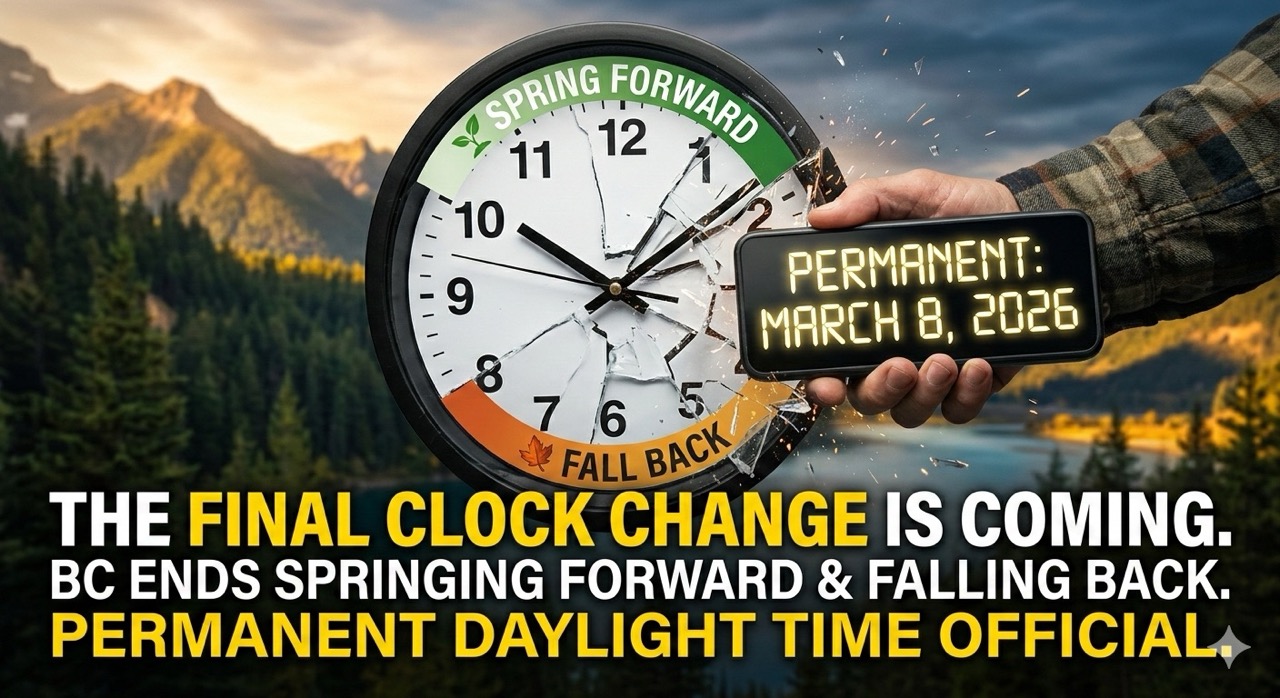
Victoria — After years of discussion and public consultation, the Government of British Columbia has officially announced that the province will end the twice-yearly practice of changing clocks and adopt permanent, year-round daylight saving time. The change will take effect after the next scheduled spring clock shift on Sunday, March 8, 2026, marking the last “spring forward” for most of the province.
Premier David Eby and Attorney General Niki Sharma made the announcement Monday, outlining how the province will transition to a new permanent time regime and how it expects the change to affect residents, businesses and cross-border coordination.
What’s Changing and When
Under the government’s plan, clocks across most of B.C. will move forward by one hour on March 8 from standard time to what is currently considered daylight saving time — UTC −7 — and that will become the province’s new, permanent Pacific Time.
The last fall clock change, usually scheduled for early November 2026, will not involve adjusting clocks back an hour. Instead, the province will remain on the March time year-round. People and businesses will have several months to prepare for the transition between March and November.
This change ends decades of seasonal time shifting in most of B.C. Some communities in eastern B.C. that observe Mountain Time — including areas around Fort St. John and Cranbrook — have had different time practices and will continue with their local arrangements, though they will align differently with the rest of the province at various points in the year under the new system.
Government Rationale and Public Support
Officials said the decision responds to strong public preference. A 2019 government engagement process drew record participation, with about 93 per cent of respondents supporting year-round daylight time.
Eby said changing clocks twice a year creates unnecessary disruption for families and businesses. He noted the province had previously delayed the move in order to stay aligned with U.S. jurisdictions in the Pacific Time Zone.
Sharma said ending seasonal time changes will reduce routine disruptions and provide greater predictability throughout the year, adding that many people welcome having more daylight in the evenings during winter months.
Alignment With Neighbouring Jurisdictions
A long-standing consideration for B.C. has been coordination with neighbouring U.S. states such as Washington, Oregon and California, which continue to observe seasonal clock changes. While those states have discussed similar proposals, they have not yet enacted permanent daylight time.
Under the new approach, B.C.’s permanent time will align year-round with Yukon, which adopted year-round time in 2020. During part of the year, B.C.’s clock will also match Alberta’s, while at other times it will differ from Pacific Standard Time in the United States.
Benefits and Concerns
Supporters of the change argue it will reduce sleep disruption, improve scheduling stability and eliminate the need for businesses and institutions to adjust systems twice a year.
Some business groups have raised concerns about the impact on cross-border trade and scheduling if neighbouring jurisdictions do not adopt similar measures. Others have questioned whether permanent daylight time, rather than permanent standard time, is the best option, particularly given darker winter mornings.
What Happens Next
- The final spring clock change will take place March 8, 2026.
- After that date, B.C. will remain on daylight time year-round.
- Government agencies and businesses are expected to prepare systems and schedules ahead of the fall period, when clocks would traditionally change back.
For most British Columbians, the practical effect will be simple: no more springing forward or falling back. Beginning in 2026, the province will stay on a single time year-round, ending a long-debated practice and reshaping how daylight hours are experienced across much of B.C.