


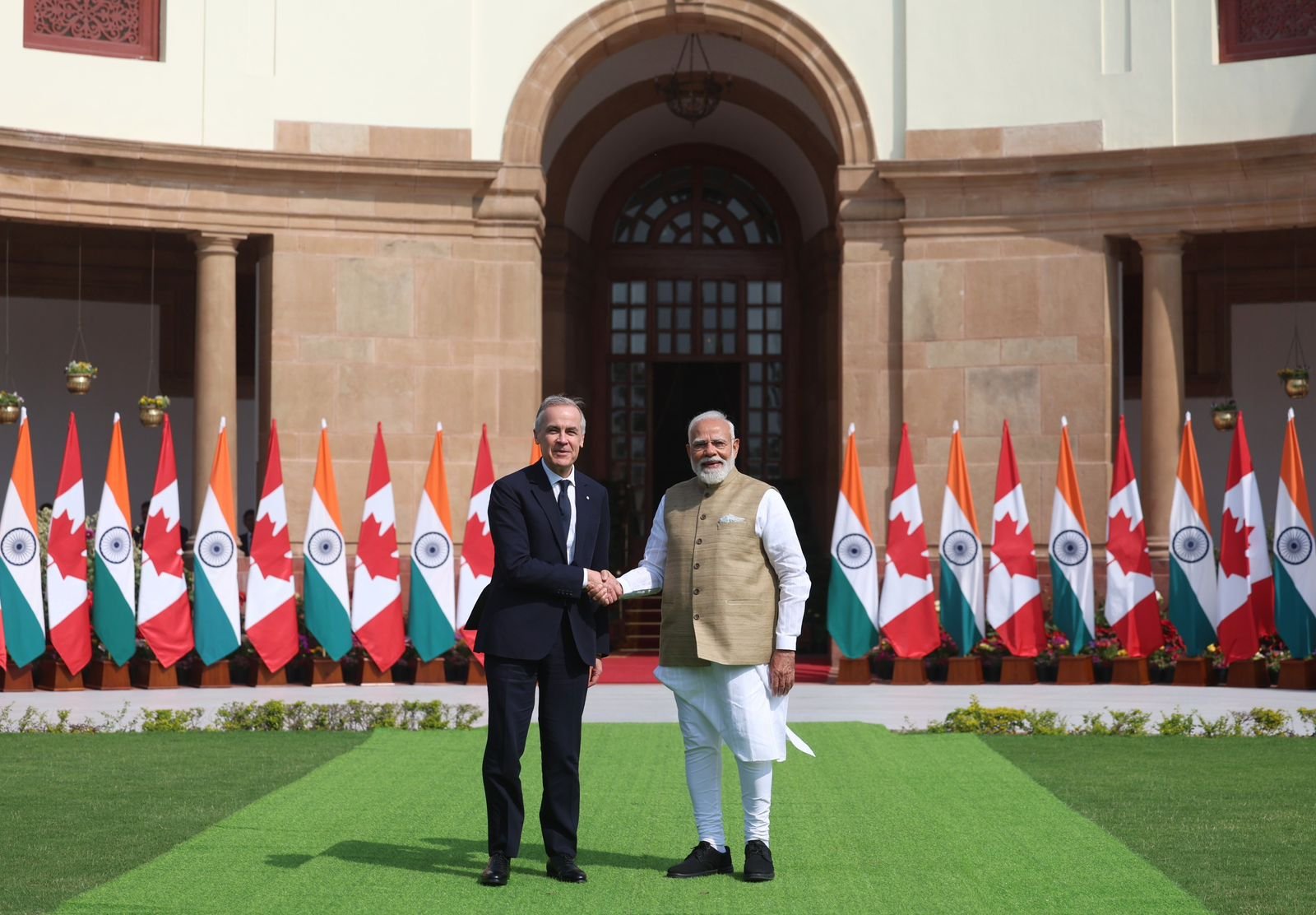
Ottawa/New Delhi — Canada is deepening its education partnership with India through a sweeping talent and innovation strategy that includes $100 million in scholarships for Indian students and a series of new university agreements spanning artificial intelligence, clean energy, agriculture and health care.The measures, announced as part of a broader Canada–India collaboration framework, are aimed at boosting student mobility, research partnerships and workforce development in sectors Ottawa has identified as critical to long-term economic growth. The strategy positions education as a central pillar of Canada’s Indo-Pacific engagement and comes as both countries seek to expand trade, innovation and people-to-people ties.
Carney I think I speak for every Canadian when I say we DO NOT WANT 60 MILLION INDIANS… we want the ones who have came in the last 15 years and the three million here illegally DEPORTED! pic.twitter.com/LlC0UDWNhQ
— Dwight Singh Shrute (@DwightSinghS) March 2, 2026
$100 Million Scholarship Commitment
A key component of the new approach is a $100-million scholarship initiative led by the University of Toronto that will support up to 200 Indian students through fully funded study opportunities. The funding is expected to cover tuition and living expenses, with recruitment anticipated to begin ahead of the 2026–27 academic year.Federal officials have framed the scholarships as a way to strengthen Canada’s global competitiveness in research and advanced skills, while reinforcing long-standing educational connections between Canadian and Indian institutions.The announcement builds on a wider Canada–India Talent and Innovation Strategy that includes expanded research internships, funded academic placements and new transnational education models designed to allow students to study across both countries.University Partnerships Formalized
As part of the strategy, Canadian and Indian institutions have signed a series of memoranda of understanding (MOUs) covering student exchanges, dual degrees, joint research and sector-specific collaboration. The agreements span British Columbia, Ontario, Nova Scotia and beyond, reflecting what officials describe as a pan-Canadian effort to engage India’s fast-growing higher education sector.| Canadian University | Indian University/Partner | Details of MOU |
|---|---|---|
| University of British Columbia | O.P. Jindal Global University | Facilitate student and faculty exchanges; support research collaboration. |
| Simon Fraser University | O.P. Jindal Global University | Explore faculty and student mobility; develop joint academic programming; advance research collaboration, including potential transnational education initiatives. |
| University of the Fraser Valley | Panjab University | Enable faculty and student mobility; support joint academic programming; expand research exchanges; use a cohort-based mobility model. |
| Algoma University | Parul University | Enable research collaboration; promote exchanges; offer short/summer courses; create pathway agreements for eligible computer science and engineering students. |
| Algoma University | Chandigarh University | Broaden existing partnership; enable research collaboration; promote exchanges; offer short/summer courses; establish pathway agreements for psychology, computer applications and management students. |
| Dalhousie University | SRM Institute of Science and Technology | Support a Nursing Dual Degree Program with 25 Indian Nursing Council-approved supernumerary seats, dual credentials and embedded Canadian clinical experience; explore pathway to nursing practice in Nova Scotia. |
| Dalhousie University | Indian Council of Agricultural Research | Collaborate in digital, climate-resilient and horticultural agriculture, aquaculture and animal husbandry; focus on joint research and broader academic cooperation. |
| University of Guelph | O.P. Jindal Global University | Facilitate student and faculty mobility for training and research. |
| Brock University | O.P. Jindal Global University | Support faculty collaborations and short, time-bounded exchanges in public health, sports management and business. |
| Royal Roads University | O.P. Jindal Global University | Support faculty and student exchange. |
| Simon Fraser University | Hydrogen Association of India | Advance joint hydrogen research; support innovation, technology development and clean-energy solutions; strengthen academic partnerships. |
| University of Toronto | Indian Institute of Science | Support AI-focused research and education collaboration, including initiatives involving the Temerty Centre for AI Research and Education in Medicine. |
| University of Toronto | Jio Institute | Collaborate on AI and management programs; promote student and faculty exchanges. |
Focus on Priority Sectors
The agreements emphasize collaboration in areas both governments have identified as strategic priorities.Artificial intelligence features prominently, with the University of Toronto partnering with the Indian Institute of Science and Jio Institute to develop joint research and education initiatives. Clean energy is another focal point, including hydrogen research led by Simon Fraser University in partnership with the Hydrogen Association of India.Health care and workforce development are also central. Dalhousie University’s nursing dual-degree arrangement with SRM Institute of Science and Technology includes 25 Indian Nursing Council-approved supernumerary seats and embedded clinical experience in Canada, with an exploration of potential pathways to nursing practice in Nova Scotia.Agriculture collaboration between Dalhousie University and the Indian Council of Agricultural Research will focus on digital and climate-resilient agriculture, horticulture, aquaculture and animal husbandry, reflecting shared concerns about food security and sustainability.Background: Education as a Strategic Lever
India remains one of the largest source countries for international students in Canada. At the same time, Ottawa has moved in recent years to recalibrate temporary resident levels, including caps on study permits, amid concerns about housing and infrastructure pressures.Federal officials have described the new Canada–India education measures as targeted and partnership-based, designed to align academic mobility with labour market needs and research priorities rather than driving broad increases in overall study permit volumes.The strategy is also tied to Canada’s broader Indo-Pacific policy, which aims to diversify economic relationships and deepen engagement with major Asian economies. Education, research and talent mobility are being framed as long-term investments that support trade, innovation and bilateral cooperation.What Happens Next
Implementation of the agreements will begin through individual institutions, with student recruitment, joint research calls and program development expected over the coming academic cycles.Universities will establish governance and oversight mechanisms for dual degrees, pathway programs and exchange cohorts. In sectors such as nursing and clean energy, regulatory and accreditation processes will guide how quickly students and researchers can transition between jurisdictions.At the federal level, officials have signalled that education will remain a cornerstone of Canada–India engagement as negotiations continue toward a broader economic partnership agreement.For Canadian students, researchers and employers, the expanded collaboration signals new opportunities for cross-border training and innovation. For Indian students, the scholarship funding and structured pathways offer additional routes into Canadian institutions and, in some cases, potential professional practice in Canada.As both countries navigate shifting global trade dynamics and demographic pressures, the renewed education partnership underscores how academic ties are increasingly intertwined with economic strategy — and how talent mobility is becoming a central feature of Canada’s international relationships.Source:
Prime Minister Carney secures ambitious new partnership with India focused on energy, talent, and technology
— Prime Minister of Canada (March 2, 2026)
















This article conveniently leaves out the last 6 most important words of the actual announcement from the PM’s office:
https://www.pm.gc.ca/en/news/news-releases/2026/03/02/prime-minister-carney-secures-ambitious-new-partnership-india-focused
“Greater student and faculty exchanges and research collaboration, including 300 funded Indian student researcher positions as well as up to $100 million from the University of Toronto for up to 200 fully funded scholarships for Indian students and outbound opportunities for Canadian students.”
Thank you for taking the time to share this and for linking directly to the Prime Minister’s official release — we genuinely appreciate readers who engage closely with the source material.
The details you’ve highlighted regarding funded student researcher positions and the University of Toronto’s scholarship commitments are indeed important. Our article references these elements within the broader Canada–India Talent and Innovation Strategy, including expanded research internships, funded academic placements, and new transnational education initiatives designed to support mobility in both directions.
At Daily Dive, we put significant effort into researching and verifying information to ensure our reporting is accurate, balanced, and grounded in primary sources. We’re grateful that you’re using our platform and contributing thoughtfully to the discussion — engaged readers like you help strengthen the conversation.
Thank you again for being part of the Daily Dive community.