
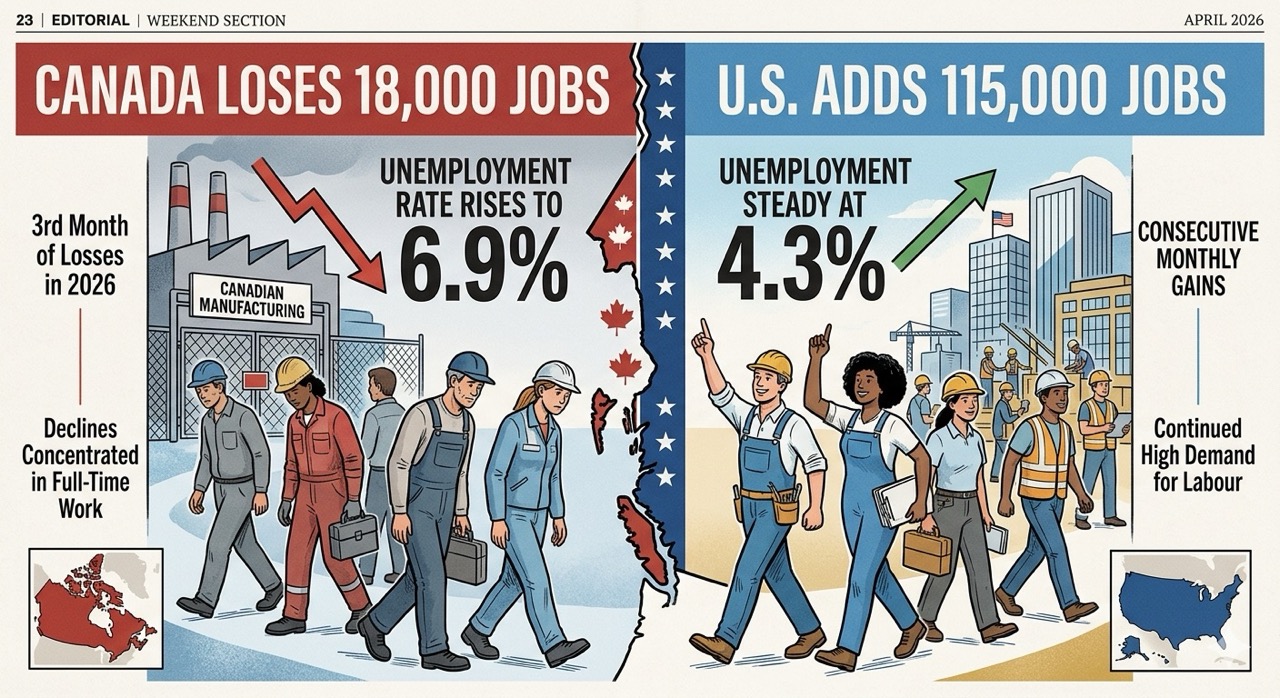
OTTAWA — Canada’s labour market weakened in April as the country lost 18,000 jobs and the unemployment rate climbed to 6.9 per cent, while the United States posted stronger-than-expected hiring gains with 115,000 new jobs and unemployment holding steady at 4.3 per cent. The diverging employment figures highlight growing differences between the Canadian and American economies as both countries navigate slowing growth, inflation pressures and global trade uncertainty.
Statistics Canada reported that Canada’s employment decline was driven largely by losses in full-time work, continuing a trend that has weighed on the labour market throughout the first part of 2026. South of the border, the U.S. Labour Department reported payroll gains that nearly doubled economists’ forecasts, signalling greater resilience in the American economy despite ongoing geopolitical and energy-market instability. :contentReference[oaicite:0]{index=0}
The Canadian unemployment rate rose from 6.7 per cent in March to 6.9 per cent in April, the highest level in six months. In contrast, the U.S. unemployment rate remained unchanged at 4.3 per cent for a second consecutive month. :contentReference[oaicite:1]{index=1}
Canada sees continued weakness in full-time work
Canada’s April losses were concentrated in full-time positions, with nearly 47,000 full-time jobs disappearing during the month. Part-time employment increased, partially offsetting the decline, but economists warned the shift points to a softer labour market and reduced business confidence.
The sectors hit hardest included construction, transportation and warehousing, industries that are closely tied to trade activity and broader economic growth. Several provinces recorded notable declines, particularly Quebec and Newfoundland and Labrador, although Ontario posted employment gains.
Younger Canadians continued to face difficult conditions. The unemployment rate for workers aged 15 to 24 climbed to 14.3 per cent, reflecting weaker hiring in sectors that traditionally employ students and entry-level workers.
Average hourly wages in Canada remained elevated, rising 4.5 per cent compared with a year earlier. However, wage growth slowed slightly from March, a sign that labour demand may be cooling.
U.S. labour market shows resilience
In the United States, employers added 115,000 jobs in April, well above expectations that ranged between 55,000 and 65,000 positions. Healthcare, transportation and warehousing, retail, and social assistance accounted for most of the gains. :contentReference[oaicite:2]{index=2}
American job growth slowed from March levels but still exceeded forecasts despite concerns about rising fuel prices, trade disruptions and uncertainty linked to conflict in the Middle East. Analysts said the report suggested the U.S. economy remains more durable than many economists anticipated earlier this year.
Federal government employment in the United States declined again in April, while manufacturing and information-sector jobs also weakened. Still, overall payroll growth remained positive enough to reassure investors and policymakers that the labour market has not stalled.
The U.S. Federal Reserve is now widely expected to hold interest rates steady in the near term as officials continue monitoring inflation and employment trends. :contentReference[oaicite:3]{index=3}
Different economic pressures emerging
The contrast between the two reports reflects broader differences in economic momentum between Canada and the United States.
Canada’s economy has been more vulnerable to slower domestic spending, weaker housing activity and uncertainty tied to trade and commodity markets. Businesses have become increasingly cautious about hiring, particularly in sectors sensitive to exports and interest rates.
The U.S. economy, meanwhile, has benefited from stronger consumer spending and continued hiring in healthcare and services industries. However, some economists warned that underlying weakness remains beneath the headline figures, including slower long-term hiring trends and declines in full-time work in certain sectors.
Both countries are also contending with inflation pressures linked to energy markets and global instability, although the impact appears to be affecting Canadian hiring more sharply.
What happens next
The latest employment reports are expected to influence central bank decisions on both sides of the border.
In Canada, the weaker labour market could reduce pressure on the Bank of Canada to raise interest rates further this year, especially if economic growth continues slowing through the summer.
In the United States, stronger-than-expected hiring may strengthen the Federal Reserve’s case for keeping rates unchanged while officials continue trying to contain inflation.
Economists will now watch whether Canada’s job losses continue into the second half of the year and whether the U.S. labour market can maintain momentum amid growing geopolitical and economic uncertainty.
- Canada lost 18,000 jobs in April and unemployment rose to 6.9%
- The U.S. added 115,000 jobs while unemployment held at 4.3%
- Canada continued losing full-time positions
- U.S. hiring was strongest in healthcare, retail and transportation
- Both countries face uncertainty tied to inflation and global instability
The April figures suggest Canada and the United States are moving through markedly different labour-market conditions despite facing many of the same global economic pressures. For Canadians, particularly younger workers and those seeking stable full-time employment, the latest numbers point to a more difficult hiring environment in the months ahead.