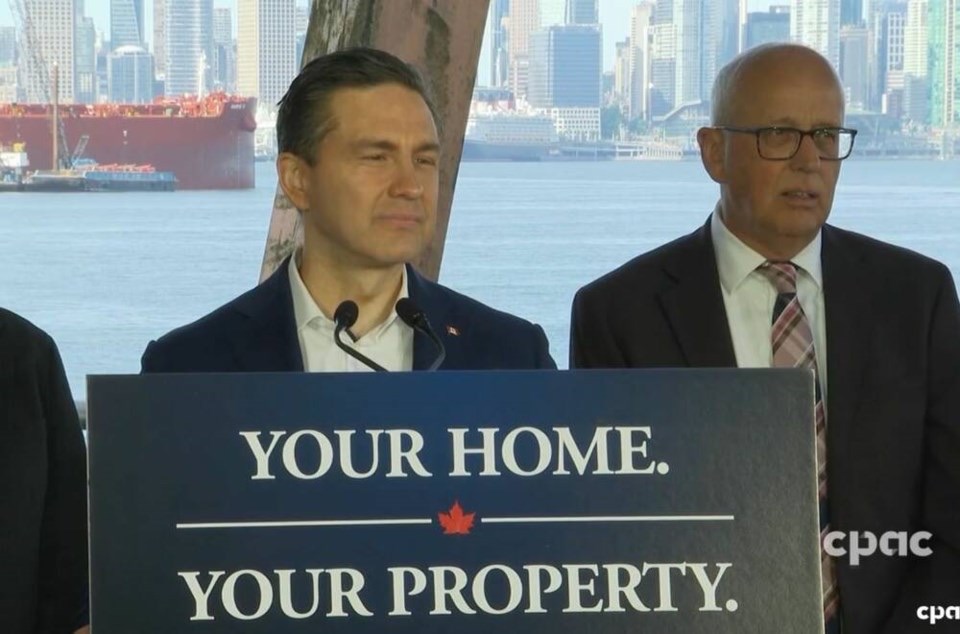
Federal Conservative Leader Pierre Poilievre is advancing a motion in Parliament aimed at strengthening private property rights following a landmark British Columbia Supreme Court ruling granting Aboriginal title to the Cowichan Tribes over roughly 1,800 acres of land in Richmond, a decision that has sparked political debate and economic concerns.
Conservative Party Pushes Property Rights Motion
Poilievre visited North Vancouver on May 21, 2026, to rally support for the motion, which seeks to reinforce protections for private landowners amid uncertainty caused by the court ruling. The BC Supreme Court decision, issued in August 2025, recognized Aboriginal title for the Cowichan Tribes over several waterfront properties, raising fears among some property owners and businesses about the security of their land titles and financial implications.
Andrew Scheer, House leader for the Conservative Party of Canada, criticized the federal Liberal government for instructing lawyers not to defend private property rights in the case. He argued that the ruling has created anxiety among homeowners approaching mortgage renewal, with some facing difficulties obtaining clear title assurances. Scheer said the Conservatives believe the government made a “massive mistake” and that the motion is necessary to address economic uncertainty.
Tom Isaac, an Aboriginal law expert with Cassels Brock & Blackwell LLP, welcomed the Conservative motion, emphasizing that claims for Aboriginal title inherently challenge existing land ownership under the Land Title Act. Isaac warned that if the Cowichan ruling is upheld on appeal, it could be catastrophic to the economy by undermining indefeasible title to land.
The following tweet from Andrew Scheer underscores the Conservative Party’s stance on property rights and the impact of the Cowichan ruling on landowners:
[TWEET_EMBED_1]
First Nations and Government Responses
Terry Teegee, Regional Chief of the B.C. Assembly of First Nations, clarified that the Cowichan Nation does not intend to claim private property but seeks to negotiate agreements with governments regarding unextinguished Indigenous rights under Section 35 of the Constitution Act, 1982. He stressed that private property can coexist with Aboriginal title through negotiation and reconciliation processes enabled by the United Nations Declaration on the Rights of Indigenous Peoples Act (DRIPA) and other legislation.
Teegee criticized the Conservative motion as fearmongering that risks damaging relationships between Indigenous peoples and the federal government. He emphasized the importance of negotiation over litigation and said First Nations have repeatedly stated they are not pursuing private property claims.
B.C. Premier David Eby said the province is limited in responding to the Cowichan ruling until all trial court determinations are made. He confirmed the government will appeal the decision once the trial concludes and that ongoing court-directed mediation with the Cowichan people aims to find a constructive path forward. Eby assured that the provincial government will not put homes or businesses at risk in negotiations.
Economic and Legal Implications
The Cowichan land ruling has caused some B.C. appraisers to add land-claims clauses in property assessments, reflecting increased uncertainty in the real estate market. Business owners in Richmond have expressed concerns about the potential financial impact and mortgage complications tied to unresolved land title issues.
Legal experts note that Aboriginal title claims, if upheld, could alter the current land title regime by introducing conditions where the Land Title Act may no longer guarantee absolute ownership. This uncertainty is central to the Conservative Party’s call for stronger legislative protections for private property.
The Conservative motion on property rights is expected to be introduced in the House of Commons on Monday, May 25, 2026, setting the stage for further parliamentary debate on balancing Indigenous land claims with private property protections.