
Canada’s unemployment rate fell to 6.6% in May 2026 as the economy added 88,000 jobs, a surprising rebound amid a technical recession.
Unexpected Job Growth Challenges Bank of Canada
Statistics Canada reported a significant increase in employment last month, with 87,800 new jobs created. This marks the largest monthly gain since December 2024 and defies economists’ expectations, who had forecasted only around 10,000 new positions. The increase was driven primarily by a surge in full-time work, which grew by 154,000, while part-time positions declined by 66,000.
Key industries leading the job growth included construction, which added 27,000 jobs, information, culture and recreation with 19,000 new positions, transportation and warehousing also at 19,000, and accommodation and food services, which gained 17,000 jobs. Despite this increase, Canada’s labour market remains complex due to the broader economic context.
The unemployment rate dropped by 0.3 percentage points from April’s 6.9%, signalling a tightening labour market. However, Canada officially entered a technical recession earlier this year, defined as two consecutive quarters of negative GDP growth, complicating the economic outlook.
The rapid job gains and falling unemployment rate have sparked debate about the Bank of Canada’s monetary policy. The central bank has raised interest rates aggressively to combat inflation, but stronger employment data may delay or prevent the anticipated rate cuts some had expected.
Sal Guatieri, senior economist at Bank of Montreal Capital Markets, described May’s job growth as “far beyond expectations.” He suggested that Canadian businesses might be adjusting to recent economic challenges, including tariffs and rising fuel costs. Guatieri said the data hints at renewed economic momentum, complicating the Bank of Canada’s task.
Claire Fan, senior economist at the Royal Bank of Canada, called the results “a good surprise” but cautioned against drawing firm conclusions from a single month’s figures. She noted that slower population growth may lower the breakeven employment rate—the number of jobs needed to keep unemployment steady—making the unemployment drop less clear-cut.
The labour market data also affects highly indebted Canadian households. Higher interest rates increase borrowing costs, which can strain household budgets. If the Bank of Canada chooses to maintain or raise rates due to stronger employment, these borrowers face additional financial pressure amid inflation concerns.
The May employment report immediately influenced financial markets. Traders reduced expectations for imminent rate cuts, instead pricing in the possibility that interest rates will stay elevated for longer. This shift also impacted risk-sensitive assets, including cryptocurrencies, which often react to changes in monetary policy expectations.
The following tweet from economist Sal Guatieri summarises the unexpected strength of the May jobs report and its implications for the Bank of Canada’s outlook:
Regional Unemployment Rates Reflect Uneven Recovery
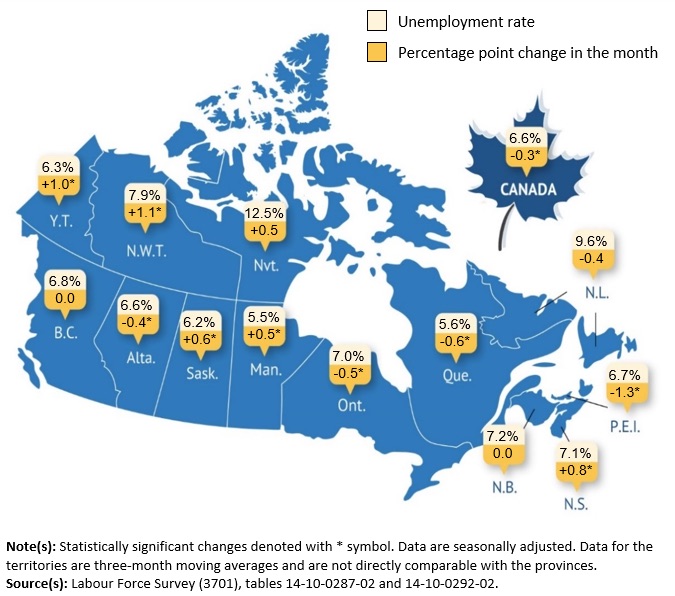
Unemployment rates across Canadian provinces and territories show a varied picture in May 2026. The national rate stood at 6.6%, down 0.3 percentage points from April, but regional differences remain pronounced, according to Statistics Canada data.
Newfoundland and Labrador experienced a high unemployment rate of 9.6%, though it decreased slightly by 0.4 points. Prince Edward Island saw a significant drop to 6.7%, down 1.3 points. Conversely, Nova Scotia’s rate rose by 0.8 points to 7.1%, while New Brunswick’s rate held steady at 7.2%.
Among larger provinces, Quebec recorded the lowest unemployment at 5.6%, down 0.6 points, followed by Manitoba at 5.5%, which increased by 0.5 points. Ontario’s rate fell to 7.0%, a 0.5 point decrease, while Alberta’s rate matched the national average at 6.6%, down 0.4 points.
The territories showed higher unemployment levels, with Nunavut at 12.5%, Yukon at 6.3%, and Northwest Territories at 7.9%, all showing modest increases compared to April. Data for the territories are based on three-month moving averages and are less directly comparable with provincial figures.
Broader Economic Context and Inflation Risks
Canada’s economy entered a technical recession earlier in 2026 due to two consecutive quarters of GDP decline. This situation typically weakens the labour market and leads to higher unemployment. However, the May jobs report suggests some resilience despite the recession.
The Bank of Canada faces a dilemma: strong employment data supports maintaining higher interest rates to curb inflation, yet the recession and high household debt argue for caution. Interest rate hikes increase borrowing costs, especially affecting highly leveraged Canadians, potentially deepening financial stress.
Inflation risks remain elevated, with the central bank wary of premature rate cuts that might reignite price pressures. The narrowing gap between current unemployment and the estimated natural rate of unemployment implies the labour market is close to full employment, limiting the scope for accommodative monetary policy.
Given these complexities, economists and policymakers face difficult trade-offs in setting interest rates. The May jobs report adds evidence that Canada’s economy may have more momentum than previously thought, but significant risks remain from inflation and debt vulnerabilities.
Reactions and Outlook
Market participants quickly adjusted their expectations following the data release. The probability of near-term Bank of Canada rate cuts diminished, with some analysts forecasting rates will remain elevated well into 2027. This shift has already influenced sectors sensitive to borrowing costs and monetary policy.
The labour market’s surprising strength also led to cautious optimism among some economists, who view the data as a sign of underlying economic resilience. However, the consensus remains that inflation control will be paramount, and the Bank of Canada is unlikely to ease policy prematurely.
Highly indebted households and businesses are expected to feel the impact of sustained high borrowing costs. Analysts warn that any further deterioration in household finances could dampen consumer spending, potentially offsetting the benefits of strong employment gains.
The Bank of Canada is scheduled to announce its next interest rate decision in the coming weeks. This report will be closely scrutinised for guidance on how the central bank intends to balance growth, inflation, and financial stability concerns going forward.