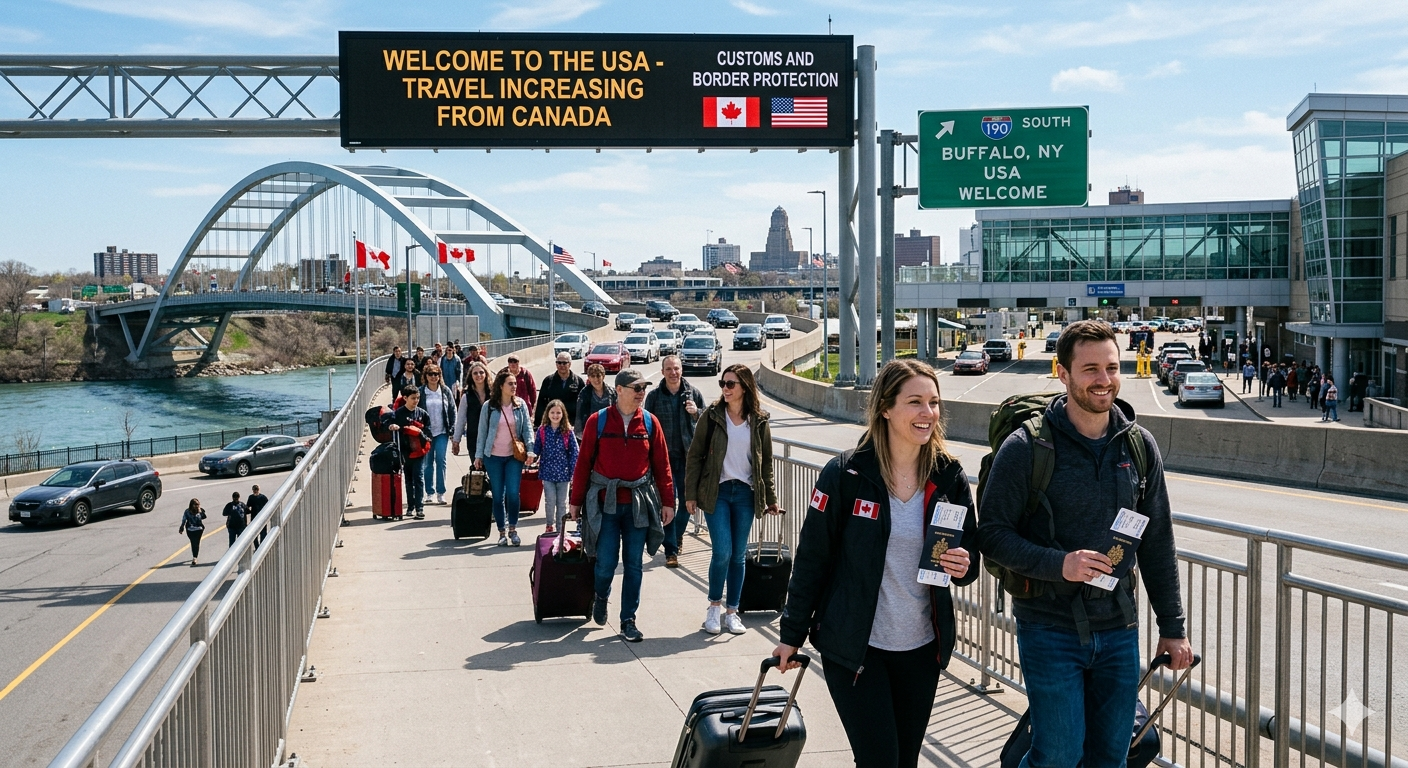
Canadian travel to the United States is showing signs of rebounding after a sharp decline that began in early 2025 amid political tensions between the two countries.
Statistics Canada reported a 9.5 per cent increase in trips by Canadians to the U.S. in May 2026 compared to the same month last year. However, travel remains well below pre-2025 levels, with total trips still down 28.7 per cent from May 2024.
“For the second consecutive month, more Canadians visited the U.S. than last year — a possible sign that one of the most successful travel boycotts is finally winding down,” said Suzanne Rowan Kelleher, a travel writer for Forbes.
How political tensions shaped travel patterns
Canadian travel to the U.S. plunged in early 2025 after then-U.S. President Donald Trump made comments about potentially making Canada the “51st state,” sparking criticism from Canadian Prime Minister Justin Trudeau. Trudeau publicly urged Canadians to avoid vacationing in the U.S., contributing to what industry experts have called a boycott.
Amir Eylon, president and CEO of Longwoods International, described the Canadian reaction as unprecedented in his 37 years in the travel industry.
“I have never seen anything like what the Canadians have pulled off,” Eylon said in an interview with Forbes in March 2026.
That boycott led to a significant economic impact for the United States. The U.S. Travel Association warned that a 10 per cent drop in Canadian visitors could cost $2.1 billion in lost spending and 140,000 hospitality sector jobs. In 2025, Canadian visitation was down 22 per cent, translating to an estimated $4.5 billion loss.
Recent data shows cautious recovery
May 2026 data from Statistics Canada shows a rebound, especially in automobile travel, which increased 15.1 per cent year over year. Air travel from Canada to the U.S., however, declined 5.5 per cent in the same period.
Despite this growth, the overall number of Canadian trips to the U.S. remains down by nearly a third compared to May 2024 levels. The increase is partly due to a base-year effect following a steep fall in 2025.
Interestingly, American travel to Canada also increased, with arrivals up 10.1 per cent in May 2026 compared to the same month last year. Automobile arrivals rose 12.7 per cent and air arrivals by 3.8 per cent. This marks four consecutive months of growth in U.S. visitors to Canada.
Implications for Canada’s tourism industry
The decline in Canadian travel to the U.S. had a mixed impact on Canada’s tourism sector. While some Canadians redirected their vacations domestically or to other international destinations, the overall outbound travel from Canada rose seven per cent in May 2026 compared to the previous year, reaching 3.1 million trips abroad.
Trips to countries other than the U.S. increased modestly, with air travel from overseas rising three per cent year over year. This suggests Canadian travellers are diversifying their destinations as they resume international travel.
However, the long-term political tensions that contributed to the travel slowdown could continue to influence travel decisions, according to surveys conducted by Longwoods International.
“Roughly six in 10 Canadians said U.S. government policies, trade practices and political statements have made them less likely to travel to the U.S. in the next 12 months,” Eylon noted.
How Canadians’ travel habits evolve in the coming months will have economic implications for both countries, given the historically strong tourism ties across the border.